Showing posts with label movie. Show all posts

Thursday, May 3, 2012

Man on a Ledge (2012)

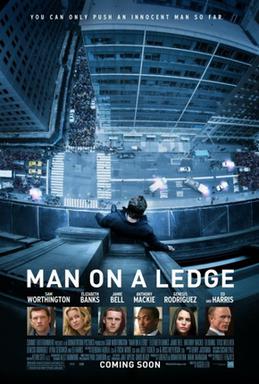
The title "Man on a Ledge," could not be more literal. A mere three minutes in, the film's main character, Nick Cassidy -- portrayed by Sam Worthington -- steps out of a New York City hotel window and onto the ledge. Had he jumped off right then and there, he may have saved the viewer an hour and a half of over-convoluted plot twists, cheesy dialogue and an overabundance of characters.

But, he doesn't jump. Instead, he balances himself on the ledge, forty floors up from the ground, and watches as national attention comes his way within minutes. Thinking he's on the verge of committing suicide, the New York City Police calls in its negotiator team, led by Jack Dougherty (Edward Burns) to try to talk him out of it.

Nick, however, is not a suicidal maniac. We learn that he is a former cop who was arrested after he was found guilty of stealing a $40 million diamond from businessman David Englander (Ed Harris.) Nick maintained his innocence, alleging that Englander employed policeman to frame Englander, and accomplished so by knocking him unconscious and placing the diamond on him. Englander's motivation would have been to collect the insurance money that he lost in the economic collapse.

Since nobody believed his story, Nick decided to take drastic action by escaping prison while granted a leave to attend his father's funeral. He eludes the supervision of his guards, but not after being involved in a fight with his brother, Joey (Jamie Bell). From then, he decided to get his story out to the world by standing on a ledge as a means to attract attention. However, his intentions are twofold; we soon learn that across the street, Joey and his girlfriend Angie (Genesis Rodriguez) are attempting to break into Englander's vault to find the diamond and prove Nick's innocence -- and that's just in the film's first 25 minutes.

Unwilling to speak to Dougherty, Nick personally requests a different negotiator named Lydia Mercer (Elizabeth Banks) who is seeking her own personal redemption. Just recently, her attempt to inhibit a potential jumper was unsuccessful, and she's been unable to sleep ever since. Supervising both Mercer and Dougherty is Dante Marcus (Titus Welliver) who tries to keep the entire situation under control, as crowds of people, including media, swarm the surrounding areas to watch the developing scene.

Sam Worthington on a ledge.
From then on, we get a cluster of different scenes, ranging from Nick's interactions with Mercer, Englander talking with his associates, shots of the crowd at the base of the building, and Joey and Angie pulling off an Entrapment/Ocean's 11-like heist as they make their way through a building en route to Englander's vault to retrieve the diamond and prove Nick's innocence. Their elaborate maneuvers involve wires, ropes, bungee cords, explosives and other tricks, which amazingly occur flawlessly even though we are given every impression that Joey is a lifelong loser and Angie is an airhead. But by far the most captivating part of the film occurs during this sequence -- when Angie changes into a tight jumpsuit, showcasing her impressively sculpted body in underwear. That scene alone is probably more interesting than the rest of the film combined.

Oh and there's one more character -- Nick's former partner Mike Ackerman (Anthony Mackie), who we quickly learn was probably not as loyal to Nick as previously believed.

The first 45 minutes or so of Man on a Ledge are bearable. While perched on the ledge, the film does a decent job developing Nick's back story, slowly informing us why he is on the ledge to begin with. But as the film progresses, too many characters are developed and the film loses its way.

Just when you are waiting for the payoff at the film's conclusion, wondering how exactly it will end, the sequence of events that materialize are almost laughable. To describe it in a word, it's a mess. Englander, who is supposed to be this brilliant, savvy businessman, makes folly after folly that ultimately leads to his demise.

But the movie puts all of it's money on a gimmick. Worthington's character spend practically all of his screen time on a ledge. To film this, director Asger Leth never shows both Worthington and the crowd hundreds of feet below in the same shot. Occasionally, we get shots from street-level that show us a man standing on a ledge, which is obviously a stuntman.

Since the movie contains so many characters, and tries to compact a convoluted storyline into a 90-minute film, I can at least vouch that Man on a Ledge never really has any lull throughout. However, I still think all parties would have been better served if Worthington's presence on the ledge lasted five minutes -- and not 90.

~ Review by Ddubbs

Wednesday, April 11, 2012

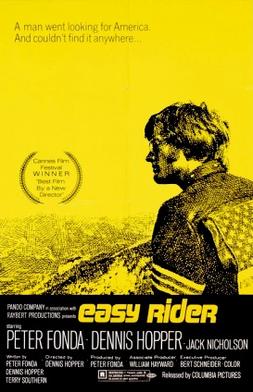
Easy Rider (1969)

In his autobiography, Peter Fonda had this to say about the movie in which he co-starred and co-wrote; "There are so many people around the world who come up to me and tell me that Easy Rider changed their lives. Most of the long-distance riders I meet tell me that I started the whole thing. I didn't start it at all. I just put it on film."

Dennis Hopper directed the iconic picture, and also served as co-star and co-writer, along with Terry Southern, who also helped write the script with the two men. The film, released at the close of the 1960s, captured the liberation and independence that the decade represented.

Normally this may be the point of the review where I introduce the setting, but Easy Rider is a road movie, and the setting is the pavement. Fonda plays Wyatt, and Hopper plays Billy, two drug-slinging hippies who are making their way towards Mardi Gras "in search of America." It seems like five minutes never pass without seeing a glimpse of the two riding down the road on their Harley Davidsons.

The context of the film doesn't really need to be described. It's the 1960s, and we all already know about hippies, we know about Woodstock, and we know about drugs. Many who read this may not have lived during this period, but we've heard this time period discussed enough by our elders. Thus, Easy Rider will no doubt have a nostalgic feel to those who experience this period firsthand.

Wyatt and Billy are close friends in the film, which goes without saying if they are willing to travel hundreds of miles together. However, their personalities are fairly different. Wyatt is as easy-going and accepting as they come, and often plays as a calming influence over Billy, who can easily become emotional and belligerent. The two travel light; aside from their Harleys, they have the clothes on their back, including their leather jackets, and plenty of herbal sustenance -- and no, I do not mean green tea.

The two don't sleep in hotels. This the 60s, they start a fire and kip on the grass when it gets too dark. But along the way, they meet some friends. At one point they pick up a hitchhiker (Luke Askew) and drive him to his commune, where they stay for a while with their new friend and his hippie comrades.

Peter Fonda and Dennis Hopper in Easy Rider
Later, after getting arrested for "parading without a permit," the two share a cell with a lawyer named George Hanson, played by Jack Nicholson. Nicholson, who gained acclaim playing intense and somewhat crazy characters in One Flew Over the Cuckoo's Nest and The Shining, instead portrays a very cool, composed, eloquent and intelligent southerner. However, his one flaw is that he's a drunk. Nonetheless, he agrees to accompany Wyatt and Billy on their quest to Mardi Gras, and for the short period he is in the film, he steals the show. Working as yet another foil to Wyatt and Billy, there is a humorous scene when he experiments with marijuana for the first time. You can easily sense his trepidation and concern in taking the druh, when he is already such an alcoholic, but of course he relents.

But the film isn't just about psychedelia and liberation. It is also about intolerance. As the trio near Mardi Gras, and are in the deep south, they stop to eat in a small rural Louisiana restaurant for replenishment. As they sit there, with their ragged appearance and unkempt hairstyles, they are heavily judged by the locals, who don't make much of an effort to keep their voices down. After a very uncomfortable few minutes where many unpleasantries are muttered from the locals, the men decide that it's best to get up and leave.

The scene exemplifies the cultural differences during this time period, and portrays to the viewer that this independent and free-wheeling lifestyle was not universally accepted by any means.

Jack Nicholson as George Hanson
The men do finally reach Mardi Gras, and the ending of the film -- in two separate scenes -- has a significant impact on the overall message of the film. Of course, I'll let the viewer figure out for themselves, but I will say this: Though the movie undoubtedly glorifies the 1960s feel of liberation and experimentation, it also tries to dispel the notion that it's all fun and games. Like any lifestyle, it's not about simply doing it, but it's about actually finding some meaning through your actions and behavior. And that is what these two men are truly seeking. Mardi Gras may be their destination, but it's really something else that they are looking for.

The soundtrack is also something to behold. With music from The Band, Jimi Hendrix, Steppenwolf and the Byrds, the movie really went all out to capture the culture of its era, and did so by employing some of the biggest and recognizable names not only of its time, but in the history of music. For any fans of classic rock, the soundtrack alone makes this film worth seeing.

Easy Rider has since become a cultural staple, and a leading pioneer of the roadie lifestyle, and deservedly so. However, as Fonda said, it wasn't his movie that started it, it was already happening it. He just put it on film for the world to see.

~ Review by Ddubbs
Thursday, March 29, 2012

Love in the Afternoon (1957)

Billy Wilder's Love in the Afternoon begins by immediately informing the viewer where we are: Paris, France. The camera pans out on a photo montage of the city, until we can view the actual city surrounding it. A French voice over, narrated by one of the film's main characters, Maurice Chevalier, tells us that Paris is not unlike any other major city in the world, except for two things, the first being that people eat better, and the second being that people make love -- not better -- but more often. Then, the film shows humorous shots of men and women kissing each other in different situations throughout the city, all in public.

No international city may be romanticized in film more than Paris. If it is the setting of the film, then you can almost guarantee that the movie will revolve around a love angle, and Love in the Afternoon is no exception. Billy Wilder, as usual, wrote, directed and produced the film. He was assisted in the screenplay by one of his common writing partners, I.A.L. Diamond, and the film is based off a short story by a French author named Claude Anet.

We meet Claude Chavasse, a private investigator portrayed by Chevalier, who is currently on the job, surveying an individual through binoculars from a rooftop, at the request of one of his clients. There is no better private eye in the city, Chavasse emphasizes throughout the film, and we quickly learn that he is smart and diligent, evidenced by the fact that he keeps all his previous records stowed away carefully in his drawers. However, he must keep a close eye not only on his subjects, but on his daughter, Ariane, played by Audrey Hepburn, who is ever so curious, and fascinated by her father's line of work.

She is young, and is spoiled by her father, who shelters her and tries his hardest to keep her separated from his work. But the harder he tries, the more curious she becomes. She's a musician, and is seen throughout the movie carrying around a large cello -- which is about twice her petite size -- but when she's not playing, she occupies her time by eavesdropping on her father's business conversations.

But the key is not to take everything too seriously; the mood and ambiance of Love in the Afternoon is light and airy. The slow, upbeat music that accompanies the film is almost meant to intoxicate you. The situations that arise in the film are comedic gold, thanks in large part to a witty and humorous script by Wilder and Diamond.

For instance, the first humorous situation happens when Chavasse reports his findings to "Monsieur X," (John McGiver) who hired him to find out whether his wife is cheating on him, which he suspects. After careful surveillance, Chavasse comes to the conclusion that she is indeed cheating on him with a rich American playboy named Frank Flanagan, portrayed by Gary Cooper. Upon informing Monsieur X of the news, he pulls out a gun, and says he is going to kill Flanagan. Chavasse, after an uninspired attempt to convince him otherwise, simply asks for his payment upfront, for if Monsieur X commits the deed, he would be in no position to make any transactions.

Gary Cooper and Audrey Hepburn in Love in the Afternoon.
Ariane, however, overhears the entire scheme, and beats Monsieur X to the hotel to give Flanagan a heads up. After very quick planning, the unfaithful wife departs from the building via the balcony, while Ariane poses as Flanagan's mistress. When Monsieur X breaks into the hotel room, gun in hand, he discovers that it is not indeed his wife, and that Chavasse must have gotten his information wrong.

We quickly discover that Flanagan is a huge womanizer, who travels from city to city on business meeting mistresses along the way. He is unmarried, and tells Ariane, "I think people should always behave as though they were between planes." He doesn't believe in love, and puts it poetically when he says, "He who loves and runs away, lives to love another day." Though Ariane may pretend that she's fine with it, the truth is, and everyone knows it, she's in love for the first time in her life.

The lightness of the film may be distorted somewhat by the drastic age difference between Hepburn and Cooper. Though their character's ages are never specified in the film, the two actors were 28 years apart when the film was made -- 28 and 56, respectively. But Wilder handles it delicately and tastefully, never showing much more in terms of flirtation between the two other than a romantic dance or an innocent kiss on the lips. The viewer is left to insinuate the rest. The subject arises once in the film, when Ariane states her distaste for young men, saying, "Actually I don't much care for young men. Never did. I find them conceited and clumsy, and very unimaginative." This is bad news for Ariane's friend and band partner, Michel (Von Doude), who is in love with Ariane, and though he may be a more acceptable beau age-wise, Ariane is oblivious to it.

While he's in Paris, Ariane only visits him in the afternoon, when she sneaks off following her band practice, so not to arouse suspicious from her protective father. While Flanagan does indeed fancy Ariane, he continually states that it is nothing serious, and Ariane combats his lack of commitment by pretending that she is also a heartbreaker, courting man after man, and inventing elaborate stories of these alleged men to make it seem more believable. In fact, Ariane doesn't even divulge her true name to Flanagan, who eventually continues on his travels, only to return a year later on business, but also to resume his courtship with Ariane.

The film, like most features around this time, handles women in a  misogynistic manner, almost like objects, but that notion is used mostly as a vehicle to convey the overlying messages of requited love and mutual respect. Cooper in his ripe age plays the part convincingly enough, more with his eloquence than anything else. Hepburn, meanwhile, is a doll, soft-spoken and graceful, and was no doubt in peak physical form when this movie was made.

The humor culminates when Flanagan hires Chavasse to investigate Ariane's true identity, and as a result, hires him to investigate his own daughter. But the film, age difference aside, is about experiencing your first love, and realizing the importance of it when you are the recipient. Though Ariane and Flanagan both enjoy each other's company, they are polar opposites in their ideas of love. Flanagan is just living "between planes," while Ariane is head-over-heels, hopelessly in love. Again, despite the noticeable age difference, there is indeed a nice chemistry between Hepburn and Cooper, making the film that much more enjoyable. Indeed, there are much worse ways to spend an afternoon.


~ Review by Ddubbs
Monday, March 26, 2012

The Hunger Games (2012) *Review 1*

This weekend, The Hunger Games took a serious bite into the record books. The film grossed $155.2 million, giving it the third highest opening weekend of all time (behind Harry Potter and the Deathly Hallows: Part 2 and The Dark Knight), making it the highest opening for a non-sequel in film history. At last Thursday's midnight premiere alone, it grossed $19.7 million, which in itself almost was enough to win the entire weekend. In short, the movie made some serious coin.

The books, written by Suzanne Collins, haven't been doing too shabby, either. Since the first book's publication in 2008, the Hunger Games trilogy has sold more than 23.5 million copies in the United States alone. Collins is also the best selling Kindle author of all time. Interest in the books picked up significantly as the release date of the film adaptation drew nearer, evidenced by the fact that 7.5 million copies of the series were sold following the release of the original trailer on Nov. 14 of last year.

Needless to say, expectations were high. Gary Ross (Pleasantville, Seabiscuit) directed the film, and also co-wrote the screenplay with Billy Ray and Collins herself. The die-hard fans paid close attention to the casting, as Jennifer Lawrence was selected to portray heroine Katniss Everdeen, who, after her Academy Award-nominated performance in Winter's Bone (where she also portrayed a resourceful, care-taking adolescent), was a pretty obvious choice. Josh Hutcherson and Liam Hensworth were picked to play Peeta and Gale, respectively, giving the younger female fans their own version of "Edward vs. Jacob," and Woody Harrelson was cast to portray the alcoholic mentor, Haymitch.

For an adaptation to become successful, it must unquestionably remain loyal to the book -- but in order to appeal to both the fan base and the casual moviegoer, it must also create its own identity while still capturing the book's overall essence. No easy task and much easier said than done.

Most people know the general synopsis of the film, so let me apologize for giving a rundown. The dystopian story takes place well into the future, following an unspecified post-apocalyptic event. The country is Panem, which is located somewhere in what was North America, and is ruled by President Snow, who is more a king, or an autocrat, than a president.

Jennifer Lawrence as Katniss Everdeen
in The Hunger Games.
The country is divided into 12 districts, which starting from District 1, become more impoverished as they go on. Whereas District 1 is a beautiful, technologically-advanced Metropolis, District 12 is decrepit, and its inhabitants live from day-to-day and meal-to-meal.

Approximately 75 years ago, the Districts joined together in a rebellion against its totalitarian government, and lost. As means of punishment, the government enacted "The Hunger Games," a yearly tournament where two "tributes" -- a boy and a girl between the ages of 12 and 18 -- are selected from each District to compete in a tournament. The tributes are placed in an arena, and are expected to fight until the death until only one stands, all while the residents of the 12 Districts watch live on television.

Our story's protagonist, Katniss, resides in District 12. Since her father died in a mining accident, she's become the primary caretaker of her younger sister, Prim (Willow Shields), and her mother (Paula Malcomson.) As a result, she is way ahead of her years, and spends the majority of her time off in the woods, illegally hunting game with her best friend and hunting partner, Gale Hawthorne.

But let's fast forward. During the 74th Hunger Games, Prim is chosen as the female tribute from District 12, and Katniss immediately volunteers to step in and take her place in order to protect her. The male tribute chosen to accompany her is Peeta Mellarck, a boy who Katniss once shared a life-changing moment with.

The movie does so many things right. It devotes the majority of its attention towards capturing both the savagery and irrationality of the Hunger Games tournament itself, which it does well. But as the book appeals to all ages, including children, a lot of the violence is shown off-scream, and heard, rather than seen directly. But it's still there and still horrifying.

Josh Hutcherson as Peeta Mellarck.
Due to fine casting, the acting is superb, carried mainly by Lawrence, Hutcherson and Harrelson, and including nice contributions from a supporting cast of Stanley Tucci, Donald Sutherland, Wes Bentley, Elizabeth Banks and Alexander Ludwig. The latter of whom, Ludwig, portrays Cato, the male tribute from District 1; in fact, all of the teenage actors who portrayed the tributes did a fine job.

As with any adaptations, the die-hard fans will be able to find plenty of things to nitpick, with one of them being the lack of screen time devoted towards the outside world during the Games. A major theme of the books include the spectacle that the Hunger Games represents to Panem, and exactly how each District reacts to them is crucial. Besides from perhaps one or two quick shots to a couple of the Districts, it is mostly lacking, and the entirety of the movie takes place within the arena of the Games. It certainly excels there, conveying the evil that lurks behind each tree, both naturally and artificially created by the government.


Liam Hemsworth as Gale Hawthorne.

But I said before how a successful adaptation must obtain its own identity while still maintaining the true essence of it's originator, and I believe The Hunger Games does that. One of the keys is getting it right during the most important scenes. The culmination of the Hunger Games tournament, which of course I won't reveal, is shot perfectly, with the just the right distribution of violence and emotional emphasis -- it is after all, teenagers killing each other; remember, they're still innocents.

The score, also, thankfully devoid of pop music, composes music solely by a orchestra, and weaves seamlessly throughout the film, enhancing the film's ambiance.

I previously emphasized the burdensome task of adapting a book that is beloved by millions of people. To tamper with a world that has been transfixed within the heart and soul of its fans, and do it incorrectly, can be considered nothing short of sacrilege. However, The Hunger Games manages to stay true to its source and, at the same time, attain its own artistic merit. The result, undoubtedly, will give its loyal readers yet another thing to love about Suzanne Collins's creation.

~Review by Ddubbs

Thursday, March 22, 2012

The Grey (2012)

On the surface, one may look at what the The Grey has to offer, and quickly surmise that it is a movie simply about a bunch of dudes who are being hunted by wolves. But then you start watching it, and you realize that the movie is actually... a bunch of dudes being hunted by wolves. It's not necessarily a bad thing, though. It just means that you know exactly what you will be getting.

I should be fair though. The Grey certainly emits nothing but pure, unrivaled masculinity, -- I believe there may have been one actress in the entire production -- between the wolves, the snow, the guns, the violence and lest not forget the new tough guy of film, Liam Neeson. It's unquestionably a movie that most guys will have to repay their girlfriends for after they somehow convince them to see this movie with them.

But that being said, The Grey does have a surprisingly sentimental and even romantic side. Amidst the fighting, the blizzards and the explicit language, there are more subtle, touching scenes thrown in that offset the savagery.

Directed by Joe Carnahan, who also wrote the script along with Ian Mackenzie Jeffers, The Grey revolves around a group of oil workers in Alaska. Away from their families, the female gender, and pretty much civilization altogether, the men make a living in the frozen arctic. It becomes evident that most of the men have this job not for the love of oil drilling, but because they need a job. Liam Neeson's character, John Ottway, is the one who protects the men from the vicious wolves who prowl the area while they work. When he sees them, he shoots them.

But when traveling back home, their plane crashes, and the surviving men are left to fend for themselves in the frozen tundra with little food and warmth. Oh, and they're being hunted by vicious wolves. Ottway explains that wolves, while dangerous, are typically harmless -- except if you are near their den.

From that point on, the men know what they are facing, and The Grey essentially becomes a monster movie. At first, the wolves are shown casually, in less harmful circumstances. But then, they become the hunters. They lurk in the dark, and they are heard rather than seen. If The Grey accomplishes anything, it's the ability to make the viewer jump. Just when you think the threat has subsided, and you are lulled into a false sense of security, here come the wolves faster than you can blink an eye.

Liam Neeson in The Grey.
Though several men survive the crash, the number naturally dwindles down to a few, and once it hits a nice round number, we begin to learn a little bit more about the survivors (Neeson, Frank Grillo, Dermot Mulroney and Dallas Roberts.) as they try to walk their way towards safety. We learn a little about their personalities, their bravery and their backgrounds. But Neeson dominates, and even at his ripe age of 59, he's still a bad son-of-a-you-know-what.

So I mentioned the sentimental scenes that mix in with the violent scenes, which mostly involve flashbacks involving Ottway with his former lover (Anne Openshaw), which Ottway uses as reassurance during the darkest of hours. The same could also be said about the script. Most of the time, it's explicit, immature and almost childish, but every now and then, a line or two will come along that carries profound meaning or even poetic eloquence. It's almost as if Carnahan intentionally made the majority of his script unimaginable, so that the few meaningful lines would stand out more. Intentional or not, it worked.

The Grey will undoubtedly please those who simply wish to see an action movie, but it will also satisfy those who prefer a little more thought in their films. Surprisingly, the movie carries a reoccurring motif, revolving mainly around death, and knowing and accepting when it is your time to go. Even the title of the film alludes to it, though I won't divulge how.

The cinematography is also pleasurable to see. Though it takes place in Alaska, it was actually shot in British Columbia, Canada, with plenty of snowy landscapes involving mountains, trees and rivers. Also, the wolves are CGI, and look pretty real for the most part, and downright vicious. Wolves may be vicious creatures to begin with, but this film undoubtedly embellishes that fact, portraying them as blood-thirsty monsters. But no one will really question that, except maybe PETA. After seeing the movie, though, I think most viewers will be pleased that when they bought a pet, they stuck with a dog or a cat.

~ Review by Ddubbs

Wednesday, March 21, 2012

All About Eve (1950)

All About Eve is a movie about "the theatre," so appropriately it begins by introducing us to its players. Narrated by the esteemed theatre critic, Addison DeWitt (George Sanders), we meet the star, Margo Channing (Bette Davis), the playwright Lloyd Richards (Hugh Marlowe), the playwright's wife Karen (Celeste Holm), the producer Max Fabian (Gregory Ratoff) and the director Bill Simpson (Gary Merrill.) The quintet are seated around a table at the then-fictional yet prestigious award ceremony, the Sarah Siddons Society. But, moments later, we learn that the special honoree isn't any of the aforementioned characters. It's all about Eve.

Eve Harrington (Anne Baxter) is the one being honored, and she stands graciously and accepts the award, looking every bit like a star who has already received more glitz and glamour that one should receive in a lifetime. But the story isn't about Eve's award, but how she got to that award.

You notice my use of quotations around the word 'theatre,' and that is because the movie makes a point to glorify the concept of the theatre. Whenever the word is mentioned in the film, it is carefully enunciated, and spoken about as if it is some magical place that only a privileged few ever get to experience. Conversely, the word "Hollywood" is given the same connotation in the movie as if one was speaking about a junkyard.

And quickly, I wrote "then-fictional Sarah Siddon's Society" because, although Sarah Siddons was indeed a real actress, at the time the movie was made, no such society existed. However, two years later, the society was formed by prominent Chicago theatre patrons, stemming from the fictional society created in All About Eve.


But let's get back to to the movie. All About Eve centers around Bette Davis, who, as Margo Channing, represents an aging star. She's experienced nothing but success her entire life, but now she is 40-years-old and still playing roles of women who are almost 10 years her junior. She is very cognizant of this fact, but her closest friends -- who are also the coworkers I listed as her tablemates in the opening paragraph -- tell her of otherwise. Bill is her lover, and also her director. Lloyd writes the plays, and his wife, Karen, is also Margo's best friend.

But then one day, Karen meets Eve, and is immediately drawn to Eve's seemingly starstruck, humble and kind demeanor. When Eve says that she idolizes Margo, Karen arranges a meeting between the two. Right away, Eve allures Margo with a tragic tale that involves her late husband, and how Margo's play is the only thing that soothes her.

Bette Davis as Margo Channing in All ABout Eve.
Eve gives every indication that she is a pleasant, good-hearted and polite individual, and sensing this, Margo agrees to hire her as her personal assistant. However, it's a decision she soon comes to regret. Rather than an asset, Eve begins to turn into a parasite in Margo's mind. At first it's for subtle reasons; Eve is too organized, she's too likable. Things then take a turn for the worst when Eve worms her way into becoming Margo's understudy for her next play, and as it turns out, she's every bit just as good as Margo - only younger.

The true splendor of All About Eve resides in writer/director Joseph Mankiewicz's script. As far as screenwriting goes, it really doesn't get any better. The dialogue is so profound and poetic, that even though it not the typical dialogue you would ever hear any normal person utter, it's still succinct and forthcoming enough that you know exactly what the characters are saying -- and possibly even better. Mankiewicz's use of metaphors and deep sarcasm only help get his points across.

For example, with his script, you get lines like this one, from critic Addison DeWitt as he is describing his profession: "For those of you who do not read, attend the theatre, or listen to unsponsored radio programs or know anything of the world in which you live, it is perhaps necessary to introduce myself. My name is Addison DeWitt. My native habitat is the theater. In it, I toil not, neither do I spin. I am a critic and a commentator. I am essential to the theatre."

But for a script to excel, you need the actors to deliver it to perfection, and they do. As much as I lauded the script, you can say the same thing about the ensemble cast of Davis, Baxter, Morrell, Sanders, Marlowe and Merrill. The group was a large part of the film's 14 Academy Award nominations (five of which were for acting), the most ever, now tied with Titanic, which also received 14 in 1998.

Anne Baxter, Bette Davis, Marilyn Monroe and George Sanders
Like Billy Wilder's Sunset Blvd., a film that was released the very same year as All About Eve, the film is about an aging actress trying to stay out of actor purgatory. That's Bette Davis, and she plays the part spectacularly. The movie also touches upon the poisonous combination of ambition and greed, and the lengths one will go to achieve stardom, which I have no doubt still relates today.

One may also note another cast-member, a 23-year-old Marilyn Monroe, playing a young actress who is trying to break into the business. This was a few years before she hit big time, and actually represented the first important role in her career. Unsurprisingly, she is gorgeous in the role, and it's interesting to see what she looked like so young in her career. Though her part is small, she holds up very well among her bigger-named colleagues, and ironically, ended up becoming the biggest star out of all of them.

But, what does that matter? Because that's in real life, and we are discussing the fictional -- yet very real -- depiction of the theatre that is presented to us in All About Eve. In a quarter over two hours, the film touches upon many subjects, but right from the opening scene, you know who the film is all about, and you'll remain interested until you see how it culminates.

~ Review by Ddubbs


Sunday, March 11, 2012

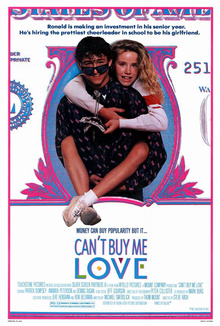
Can't Buy Me Love (1987)

There are times when you need to prevent yourself from viewing a movie through a critical lens, and just enjoy it for what it is. Call it a guilty pleasure if you must. On these occasions, tearing down the barrier that divides the movie and the critic can allow you to form an attachment to a film that is forever binding.

Can't Buy Me Love, whose title was undoubtedly inspired by the popular Beatles's song of the same name, appropriately opens with that very song. Right then and there, you knew the film would have good taste in music.

It is a popular theme in movies to take a close look at the high-school cultural hierarchy that exists in America. When this happens, it's always interesting to see how it is interpreted by each specific movie. It's so popular that any casual moviegoer can identify a handful of such movies off the top of their head, most of which will probably be fairly recent creations. However, Can't Buy Me Love, made in 1987, more than likely came first.

The film, written by Michael Swerdick and directed by Steve Rash, stars a young Patrick Dempsey as Ronald Miller. We first see him riding a lawn mower, staring longingly at "the cools" in his school, namely Cindy Mancini, played by Amanda Peterson. With curly, unkempt hair, goofy glasses, and a puny physique, Ronald is your stereotypical nerd. Cindy, meanwhile, has blond hair and a pretty face, is the coolest girl in school, and for Ronald, represents the unattainable.

Set in Arizona, the film makes sure to establish the relationship between Cindy and Ronald right away, and we learn that it is nonexistent. Cindy is seen standing on her own doorstep, confronted by her mother (Sharon Farrell), who says to her, "Why can't you be more mature like the Miller boy?" The camera then cuts to Ronald, who is mowing their lawn, which at that moment -- conveniently -- spits grassy residue back in his face. Cindy is reduced to laughter, and replies, "Mother, get serious."

Patrick Dempsey in Can't Buy Me Love
But in reality, Ronald has everything going for him. He's incredibly intelligent and a hard-worker, the latter of which earned him $1,500 from mowing lawns all summer long. But there's one thing missing that Ronald, a high school senior, wants -- popularity. He knows that, as a senior, he has one more chance to make his mark.

The opportunity finally presents itself when he's at the mall one afternoon. Ronald, having an interest in astronomy, plans to spend his summer earnings on a fancy new telescope. However, while at the mall, he discovers a better investment. He spots a distressed Cindy, who recently ruined her mother's best dress, and is trying to replace it to no avail. Since she can't afford the $1,000 for a new dress, that's when Ronald steps in. He gives Cindy a proposition she can't refuse; he'll buy her the dress, but she has to pretend to be his girlfriend for a month. And just like that, you have your plot.

Can't Buy Me Love is not original by any means. It plays off the most common of stereotypes, and the dialogue is fairly basic. But the movie has passion. Dempsey plays Ronald with a deep intensity, as if he knew that he was representing the geeks of America who all wish to have their chance with the head cheerleader.

Having no idea how to act "cool," it's humorous at first for the viewer to see Ronald's behavior. But slowly and surely, his plan actually starts to work. He ditches his nerdy best friend Kenneth (Courtney Gains) and makes new, cooler friends (Cort McCown, Eric Bruskotter). Cindy, abiding by their "contractual agreement," does her part by spending time with Ronald, and even gives him some fashion advice. And just like that, Ronald disappears and Ronnie is born.

As predicted, the new-found popularity develops an inflated ego in Ronald's head. He's pursued by other girls in the school, and suddenly, his popularity reaches "legendary status." But even though he's changing, the old Ronnie still comes out when he's with Cindy, and in another unsurprising turn of events, it turns out the two of them are actually very compatible. In a scene emblazoned in 80s cinema lore, Ronald and Cindy are together at an airplane graveyard, which until then was Ronald's "private place." By letting her in, she subsequently let's him in, and before you know it, Cindy starts to see Ronald in an entirely new light.

I probably didn't need to give that elaborate rundown of the plot. I could have given you one single line of plot synopsis, and you could have guessed the entire movie. But that doesn't mean you can't still enjoy the movie, or even come to love the movie. It's a story for the romantics at heart, and will remind everyone of that one girl in their lives who they never thought they had a chance with.

Dempsey and Amanda Peters riding off on a lawn mower.
The movie also scrutinizes social classes, and Ronald gives an impassioned and emotional speech on the subject later in the movie, which brings the movie back to it's original message. Though Ronald exhibits his plan to perfection, only to have it inevitably backfire in his face, he of course learns a valuable life lesson along the way that tells us that we can't really change who we are. He manages to put everything into perspective while delivering a perfect heart-wrenching speech to Cindy at the film's close, encompassing all that he -- and the viewer -- has learned in the last 90 minutes. It's a speech that will make the hopeless romantics of the world tremble with joy.

Call it cliche, call it unoriginal, but Can't Buy Me Love will make you feel something. It's an endearing movie that you can watch over and over again. Patrick Dempsey plays an extremely memorable character in Ronald Miller, and Amanda Peterson is nothing short of beautiful to look at. You may also note the introduction of a young Seth Green, who plays Ronald's younger brother, Chuckie. And like John Cusack lifting the boom box in Say Anything, Patrick Dempsey riding off on a lawn mower will be another 80s scene that you'll never forget.

~ Review by Ddubbs

Saturday, March 10, 2012

My Left Foot (1989)

Everybody remembers Daniel Day Lewis's performance that earned him his second Academy Award, portraying the greedy yet impassioned Daniel Plainview in 2007's There Will Be Blood. That film also made it impossible to drink a milkshake and not think of Daniel Day Lewis. However, fewer may recall the film that netted him his first Academy Award, playing Christy Brown in My Left Foot.

Lewis has portrayed a variety of characters in his career that have showcased his acting abilities -- ranging from oil tycoons, 19th century mob bosses, to wrongly accused Irish activists -- but never has a portrayal showcased his abilities more than his performance of the cerebral palsy-afflicted Christy Brown.

My Left Foot, directed by Jim Sheridan, tells the story of Christy, based on his own autobiography of the same name, which was adapted to the screen by Shane Connaughton and Sheridan. The fact that the Christy was able to tell his own story is a triumph in itself. Christy, who suffers from Cerebral Palsy, had one controllable limb -- his left foot. With that foot, he taught himself how to write and paint, and not only write and paint well enough for a man with one foot, but well enough to become an actual artist.

A lot of My Left Foot deals with ignorance in the early 20th century. The biopic begins at the very beginning of Christy's life, at birth in Dublin, Ireland. Right away, doctors know that something is wrong with him, and shortly thereafter, he is diagnosed with Cerebral Palsy, a condition that affects motor abilities. The term "Cerebral Palsy" is a vague, and the symptoms of those who have it range extravagantly on a case-by-case basis. But so little is known about the condition that Christy is simply dismissed as a "cripple." In a blue-collar Ireland town, where families depend on hard work and labor to get by, it was almost considered shameful to have such a child.

That notion is evidenced by Christy's father, Paddy, (Roy McAnally), a man with a lot of pride but very little to show for it, who all but disregards Christy as his son at his young age. But Christy's mother, Bridget, played excellently by Brenda Flicker, certainly doesn't disregard. She gives him all the motherly nurturing and care that anybody could ask for, and never once questions why one of her children has to suffer. Christy is one of five children, having two sisters (Alison Whelan and Kirtsen Sheridan) and two brothers (Declan Croghan and Eanna MacLiam), none of whom are disabled.

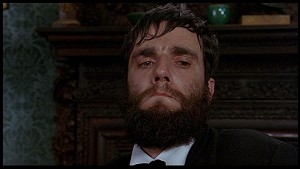
Daniel Day Lewis as Christy Brown in My Left Foot.
The young Christy Brown is played by Hugh O'Connor. Early scenes in the movie show the family surrounded at the dinner table, and Christy shoved aside, lying on the floor, as if he is the family pet. But we soon learn that there is more to Christy than meets the eye. He can't walk, or control his speech enough to speak intelligibly, nor as he had schooling, but the viewer finds out early in two separate scenes that Christy does indeed have normal human abilities.

The first scene involves Christy at home alone with Bridget. After hearing a loud noise, Christy crawls over to the top of the stairs to see what happened, and witnesses Bridget lying motionless at the bottom of the stairs. Using all the strength he could muster, he heroically topples down the stairs, and slams his left foot into the front door until he attracts attention from the neighbors, thus saving his mother's life.

The second scene, almost immediately after, shows the Brown family circled around the table, with the children working on their homework. One of Christy's brothers asks aloud, "What is 25 percent of a quarter?" No one else in the family knows the answer, and Paddy goes as far as saying, that "That's a stupid question. Twenty-five percent is a quarter. You can't divide a quarter of a quarter." Hearing this, Christy grasps a piece of chalk between his left toes, and begins to write something on the floor. His family watches as he struggles to writes something, but it's so sloppy that they shrug it off as gibberish. However, the viewer can tell that what he wrote is the fraction "1/16," thus answering the question and indicating that he is not only smart -- but the smartest one in his whole family.

The movie intertwines time in Christy's life. Every now and then we cut to "the present," which shows an elder Christy at a banquet, accompanied by a woman named Mary (Ruth McCabe.) Christy makes many attempts to court Mary, who actually happens to be reading his book. Christy is able to communicate with Mary easily, showing clear speech, therefore letting us know that somewhere along the line, he is taught how to clearly speak.

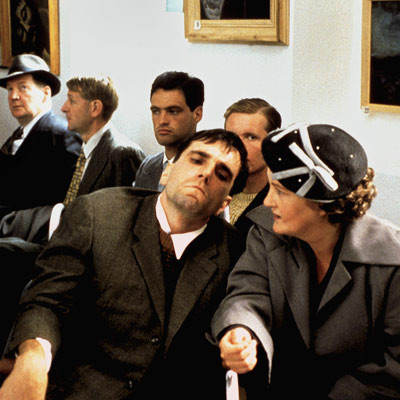
Daniel Day Lewis and Brenda Flicker
This comes to fruition when, cutting back to the past, Dr. Eileen Cole (Fiona Shaw) knocks on the Brown's doorsteps one day. She is a physical therapist who works directly with individuals with cerebral palsy, and she wants to help Christy. This scene, at last, represents the breakthrough that finally arrived as far as medical treatment and understanding in Ireland. With Cole's help, Christy is able to become a competent member of society. He speaks clearly for the first time, and starts painting lovely pictures that eventually gain him acclaim. He also falls in love with Cole, which doesn't end too well.

But as Christy ages, his likability starts to go the opposite way. Once the young, misunderstood and tragic figure, Christy was impossible not to like. But as an adult, Christy becomes a drunk, and a belligerent individual. But it's understood, given what he has to go through.

As a biopic, the movie travels at a slow pace. But the point is to show that disabled does not mean dysfunctional. Christy is one of many handicapped individuals who have accomplished great things, even when society tells them they can't. And that's where Daniel Day Lewis's brilliance comes in. We know the man is pure method, and I can't even imagine the research he must have done before tackling this role. How he so convincingly plays a man who suffers from a condition that causes uncontrollable movement and unintelligible speech is beyond imagination. It's truly a unique performance like no other.

The movie doesn't only give us insight into the lives of individuals who require special needs, but also shows us the ins and outs of lower class families in early 20th century Ireland. But the point of the movie is to highlight Christy's accomplishments in the face of major adversity. His plight is extraordinary, no doubt, even if it didn't begin on the right foot.

~ Review by Ddubbs

Sponsored by criminal attorney Kenneth Mollins 

Wednesday, March 7, 2012

Say Anything... (1989)

The iconic scene in Say Anything... -- which features Lloyd Dobler, played by John Cusack, wearing a trench coat and standing outside the house of Diane Court (Ione Skye), raising a boom box in the air playing Peter Gabriel's "In Your Eyes" while standing in front of his blue Chevy Malibu -- is not even all that conducive towards the film's plot.

The scene is also extremely antiquated; stereos have since been replaced by CD players, and then iPods, trench coats have been replaced by, well, anything but trench coats, and Chevrolet even ceased production of the Malibu in 1983, before bringing it back in 1997.

Alright, so maybe it's not conducive from a plot standpoint -- the scene doesn't even evoke a reaction from Diane, or at least one that we see. But it's the scene that resonates the most because it embodies the emotion that Say Anything... puts forth. The 1980s cult classic is about young love, and the desperation that comes with it, and the certainty of the love that one feels during a time of deepest uncertainty.

John Cusack, the pioneer of 1980s teenage/young adult romantic coming-of-age films, could not be more endearing as Lloyd Dobler. Perhaps he's not the most good-looking guy in the world, but he's tall, well-spoken, polite, funny and most importantly of all, sensitive.

Say Anything... is the third movie that Cameron Crowe wrote, but the first that he directed. Though he has gone on to make some outstanding films, one can make the argument that Say Anything... is his most memorable.

Set in Seattle, the film revolves around Lloyd, who, with his fellow classmates, just graduated from high school. Lloyd has his sights set on the Diane Court, the grade-A student who gives the graduation speech to her classmates as they prepare to embark on the next journey in their lives. Court sets the tone of the film, early, when she strays away from her prepared speech to let out her real feelings, "I have to be honest though, I have all the hope and ambition in the world, but when I think about the future, the truth is, I am really scared."

The iconic scene from Say Anything...
Every generation has their own movies that they relate to. They came out at the perfect time, when you were on the brink of adulthood, and somehow, they manage to capture your adolescent experience. As a member Generation Y, those films for me are Can't Hardly Wait, or American Pie. But for those who belong to Generation X, Say Anything... tops that list. Not one character in the film is sure of anything, except for Lloyd Dobler, who knows for sure that he loves Diane.

Lloyd first propositions Court through an endearing phone call, trying to convince her to go out with him. At first, she politely turns him down, but after a few romantic words, he makes her laugh, and she changes her mind. The two accompany one another to the big graduation house party (every movie has one), and the rest is history.

Diane is smart and pretty, but also has high values and is a "goody two-shoes," so to speak. She spends her time volunteering at a nursing home, and she regularly checks in with her father (John Mahoney), who she loves very much. Her parents divorced five years prior, and Diane chose to live with her father, and as a result, he became very protective of her. Diane idolizes her father, and that's why a stir is caused, when, midway through the film, the IRS comes knocking on his door, informing him that they will be conducting a criminal investigation on him for tax fraud. This antiquated notion throws Diane into a whirlwind, which conflicts with her growing relationship with Lloyd.

Though Diane has things pretty figured out -- she just won a fellowship to study in England for a year -- Lloyd doesn't. He has aspirations to be a kick boxer, which he labels as "a growing sport," and when asked what he plans to do for the summer, he answers, "to spend as much time as possible with Diane before she leaves."

Say Anything... doesn't attempt to provide answers, or solve any problems, but just tries to capture the uncertainty that comes with the transition from high school to "the real world" in a charming and committed way. But the real charm of the film stems from Crowe's script, where we get hilarious yet insightful lines like, "She's gone. She gave me a pen. I gave her my heart, she gave me a pen."

John Cusack and Ione Skye.
Along the way we meet other enjoyable characters, like Lloyd's friends Corey and D.C. (Lily Taylor and Amy Brooks, respectively), Corey's boneheaded ex (Loren Dean), and Lloyd's sister, played by his real sister, Joan Cusack.

Say Anything... puts a face to a generation of lost souls who did not know what their next move was. Though over 20 years old, and a bit outdated at times, the film still remains extremely relevant. And with the movie, John Cusack established himself as the representative of Generation X. When he speaks in the film, you could see his brain at work, searching for the right words to express his true emotion. Most of the time, he finds them, and other times, he just says anything that comes to him.

~Review by Ddubbs

Sponsored by criminal attorney Kenneth Mollins 

Sunday, March 4, 2012

The Muppets (2011)

It's time to play the music. It's time to light the lights. It's time to meet the Muppets. But first... it's time to write a review.

The Muppet Show may have been short-lived, airing from 1976-1981, but it's legacy certainly isn't. Jim Henson's wacky conception of the Muppets has since become a part of cultural lore. Before we can even speak as children, we already know who Kermit the Frog and Miss Piggy are. Resultant movies, such as the 1975 The Muppet Movie, 1992's The Muppet Christmas Carol, and even the late 80's children's show Muppet Babies have all stemmed from Henson's creation to great success.

Jim Henson died at the age of 53 of organ failure, which resulted from streptococcus. Though he was the voice of many of the Muppets, including Kermit, longtime friend and voice actor Steve Whitmire took over duties as Kermit's voice, and Henson's legacy continued to live on.

So it's understandable that, in 2008, when buzz began circulating that popular comedic actor Jason Segel would be writing a script for a new Muppet movie, that the news was met with excitement by Muppet and movie lovers alike. Segel has a proven track record with his screenwriting, having written and starred in the highly successful 2008 comedy Forgetting Sarah Marshall. Nicholas Stoller, Segel's buddy who directed the film, was also selected to co-write the script with Segel.

Segel is an avid Muppet fan, and in fact, next time you watch Forgetting Sarah Marshall, you may notice during the montage after he returns home from Hawaii, that his character can be seen playing the Muppets theme on the piano.

Walter, Jason Segel and Amy Adams in The Muppets.
Three years later, the movie was released and immediately received critical and commercial success. It's directed by James Bobin, who really is making his major motion picture directorial debut. The movie plays off the notion that the Muppets have been long forgotten. Jason Segel plays Gary, a very jolly man child who humorously is brothers with a Muppet named Walter. Gary's longtime girlfriend, Mary, is played very delightfully by the incandescent Amy Adams, who was an obvious choice for the role.

As a Muppet, Walter finds himself out-of-place in contemporary society. So to help him discover his roots, Gary purchases a ticket for Walter to accompany him and Mary on a trip to Los Angeles, where they can visit the Muppet studio. However, when they get there, they sadly discover that the studio is a rotted and decrepit. During their tour, Walter overhears the plans of oil tycoon Tex Richman, played by Chris Cooper, who states his intention to purchase the studio, only so he can tear it down and drill underneath, where an abundance of oil resides.

The last hope for the Muppets is for Gary, Walter and Mary to seek out the Muppets themselves, and reunite them to put one last final show to raise enough money to save their studio. They start with Kermit, and go Muppet by Muppet until they can round up them all.

The Muppets in travel.
The Muppets is everything that a musical should be. It is cute, adorable, amusing, funny and endearing. Segel and Stoller's script doesn't take itself too seriously. Many jokes are made to parody the film-making process, such as outwardly acknowledging the silliness of singing and dancing in public, and the phrase "travel by map" will become one of your favorite things to say.

Additionally, the music in The Muppets is fantastic. Original songs such as "Man or Muppet," and "Pictures in My Head," are delightful, and of course, you'll also hear Muppet classics like as the original theme as well as Kermit's famous song, "Rainbow Connection."

Segel, Adams and Cooper are all great, but the movie belongs to the Muppets. Watching the live-screen versions of Kermit, Miss Piggy, Gonzo, Fozzy, Animal, Beaker, Scooter and Waldorf will evoke a huge wave of nostalgia that will remain with you long after the credits roll.

Whether you're a Muppet lover or not, there's very little to not like about the The Muppets. It's certainly directed towards children, but the comedy is intelligent enough that it could appeal to all ages. Also, I mentioned earlier how the film is a comeback movie. Segel's script depicts the Muppets as forgotten and irrelevant, which before this movie, they basically were. With that, the movie carries very real and relatable themes, such as redemption and the importance of friendship.

Jim Henson may be gone, but The Muppets reignites the magic that he conjured when he first created the characters over 30 years ago. Muppet or man, whatever, it doesn't matter, because Segel and Stoller's script brings them to life in the most real of ways.

~ Review by Ddubbs

Thursday, March 1, 2012

Lilies of the Field (1963)

It has been a long-standing notion in cinema to romanticize the idea of the drifter. The mysterious, aimless, underachiever strolls into a new town and is exposed to a new set of cultural rules and customs. Furthermore, the idea of unparalleled independence is something that appeals to everybody at some point or another. Lilies of the Field explores those concept in a big way.

The 1963 film, directed by Ralph Nelson, is based off a 1962 book of the same name by William Edmund Barrett. James Poe adapted the novel for the screen. It stars Sidney Potier and Lilia Skala, who, in the film, could not be more different from each other.

The film opens with Homer Smith, played by Potier, driving into an Arizona farm in need of water for his car. The farm happens to be inhabited by a group of East German nuns, headed by Mother Maria, (Skala) and four other sisters (Lisa Mann, Isa Crino, Francesca Jarvis and Pamela Branch.) All Homer wants is to get some water so he could move on and find some work. He's a handyman, who travels from place to place with his box of tools, looking for whatever he can fix.

Believing that Homer was sent to them by God, the nuns first ask him if he could repair their leaking roof. Homer, a nice guy, obliges, but then wishes to leave and continue on his way. But the nuns are not going to let their "gift from God" get away so quickly. They have a bigger plan for him.

The first twenty-five minutes of Lilies of the Field plays off as a screwball comedy. Though they don't pay him money in return for his services, the nuns offer Homer food, kindness and shelter -- the latter of which he rejects. With the exception of the Mother Maria, the other four nuns can barely speak English, and dinner in the farm becomes language class, with Homer teaching them English. The interactions between the German nuns and Homer are extremely humorous, and really showcase Potier's ability to act. The showcase was exemplary enough, in fact, that it was able to net him the Oscar for the Best Actor in a Leading Role in 1964.

Homer tries hard to leave, but just can't leave the poor nuns behind. Finally, the plot thickens when Homer discovers what the nuns have in mind for him: they wish for him to build a chapel on their farm. The small Arizona town only boasts one "church", and it is located in the back of an RV. To get there each Sunday, the nuns, walk miles down the street in the swarming desert heat.

Sidney Potier and Lilia Skala in Lilies of the Field.
Homer is incredulous at first, but for the viewer, there is never any doubt what he is going to do. Throughout the film, Homer is constantly asking for money in return for his services. But it is not truly what he is after. Homer is seeking self-worth, value and redemption. When he finally agrees, to build a chapel, he wishes to do it himself, and only himself.

A main theme of Lilies of the Field is unity in the face of diversity. Homer, an African-American, is not a religious man, and yet, he bonds with the devout East German nuns. Though they are as different as can be, they don't question one another's practices -- quite the opposite. They respect one another. When Homer does embark on his mission to build the chapel, he enlists the help of a local bar proprietor named Juan (Stanley Adams), and his Latin American friends, adding another example of people of different cultures coming together for a common cause.

Naturally, the film does contain some religion, with Potier showing off his vocal ability and singing some religious hymns with the nuns. Some bible verses are read too. When Homer demands payment at first, he recites a verse, "The laborer is worthy of his hire," to which Mother Maria responds with another verse, "Consider the lilies of the field, how they grow; they toil not, neither do they spin. And yet I say unto you that even Solomon in all his glory was not arrayed like one of these." And just like that, you have your title.

While Lilies of the Field may romanticize the drifter, it also romanticizes the idea of accomplishing something. It puts aside some of the material items in life that people value, namely money, and highlights some abstract qualities, like unity, respect and acceptance. With such a message, it is undoubtedly a movie that many people can learn a lot from.

~ Review by Ddubbs

Wednesday, February 29, 2012

The Adventures of Tintin (2011)

Before he died in 1983, Belgian writer and artist Georges Remi developed a friendship with movie director Steven Spielberg. After the befriending, Remi publicly stated that if his comic, The Adventures of Tintin were to ever be adapted to the big screen, that Spielberg would be the ideal filmmaker to spearhead the project. Twenty-eight years later, Spielberg abided.

The Adventures of Tintin is a comic that first appeared in a Belgian newspaper in 1929. Since then, the series evolved into 24 books, with publication dates ranging from 1929 to 1986, which have been translated in over 50 languages and have sold over 200 million copies worldwide. So it wouldn't be surprising if Spielberg felt a tiny bit of pressure when creating the first film adaptation of the story.

Spielberg and Peter Jackson signed on to co-produced three Tintin films, and used Jackson's company to provide the animation and special effects. The story they chose to start with was "The Secret of the Unicorn," which was published in two parts by Remi in 1942 and 1943.

The stories, and Spielberg's subsequent film, revolve around Tintin, a reporter who has a thirst for adventure. He is young, wide-eyed and brave, and never turns down an opportunity for a good story. His reporter-like curiosities in his vocation have led him on a myriad of adventures, and are the impetus for all of the Tintin tales. "The Secrets of the Unicorn" is no exception.

First and foremost, let's just say that the animation in Spielberg's The Adventures of Tintin is nothing short of stunning. There's no question that animation has evolved over the last decade, but never before has it looked more realistic than it does here. Naturally, the human beings still look clearly animated, but the scenery in the film, and the background props -- bookshelves, tables, lamps, etc. -- look genuinely real. Welta Studios, Jackson's company who created the animation, have also done the effects for other visually-stunning films, such as the three Lord of the Rings films, King Kong and Avatar. But this may be the best animation yet.

Anyway, the film wastes no time jumping into the action. We meet Tintin, who is voiced by Jamie Bell, accompanied by his faithful dog, Snowy. He is at an outdoor fair somewhere in Europe, and his eyes immediately become attracted to a model ship, called the Unicorn, that is being sold at a booth. Tintin makes the purchase, and immediately is confronted by a man named Ivan Sakharine (voiced by Daniel Craig), who wishes to buy the ship from Tintin for an outstanding price. Using his keen sense of intuition and adventure, Tintin refuses to sell it. He's immediately warned by Sakharine that the ship will only bring him trouble, but knowing Tintin, that only fuels his interest.

Haddock, Tintin and Snowy in The Adventures of Tintin
Shortly thereafter, Tintin's apartment is ransacked and the ship is stolen. Being the astute reporter he is, Tintin immediately embarks for the local public library, where he looks into the history of the actual ship, the Unicorn, only to learn that there is, of course, a story behind it. Many years ago, the ship set sail on a voyage, only to never return.

Tintin's continued digging puts him right in the heart of the adventure. He teams up with a ship captain, named Haddock (voiced by Andy Serkis), who has his own motives towards the adventure, to discover what happened to the Unicorn on its fateful voyage many years ago.

The Adventures of Tintin is for the the young-at-heart, enthusiastic adventurists who have always dreamed of embarking on their own journeys to solve an epic mystery. I wouldn't necessarily say that Tintin is a a kids' movie, but there's no doubt that children are one of the target audiences, and therefore you must bear with the film a little when the action becomes a bit outlandish and unrealistic. When that happens, just absorb the amazing visuals that Spielberg and Jackson present to us. Also, the dialogue is funny and endearing enough to appeal to all ages.

Of course, as the plot thickens, mysteries will untangle , formidable foes will step in Tintin's way, and unexpected allies will come to his aid when he needs them most. That is what adventures are all about, and this story has them in spades.
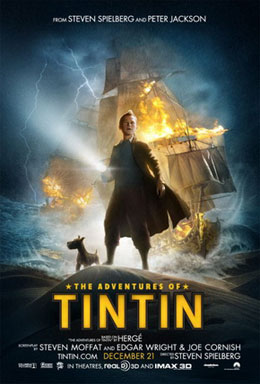
Tintin holding a cartoon depiction of himself, as
he is portrayed in Georges Remi's original comics

Spielberg of course pays homage to the original writer, Georges Remi, who went by his pen name, Hergé. In the opening scene of the film, Tintin is being drawn by a cartoonist, who is meant to be the actual Georges Remi, and the resultant drawing is a depiction of the original cartoon Tintin. Additionally, other characters who were staples in Remi's popular books make appearances, like the incompetent detectives, Thomson and Thompson (voiced by Nick frost and Simon Pegg, respectively.)

With The Adventures of Tintin, you will see the world. You'll watch as Tintin and Snowy sail across oceans, walk through deserts, run through cities, and fly through the skies. From start to finish, the animation will amaze you, and Tintin's wide-eyed hopefulness will inspire you. No doubt, Georges Remi did indeed pick the ideal filmmaker to bring his timeless stories to life.

~ Review by Ddubbs

Sunday, February 19, 2012

Anatomy of a Murder (1959)

For cinephiles, Anatomy of a Murder may be the film equivalent of what "The Fight of the Century" was to sports fans. Muhammad Ali and Joe Frazier, the two giants of the sport, going to-to-toe for 15 epic rounds in Madison Square Garden. It was a spoil of riches for sports fans, and something that I, having been born 17 years after the fight, never got to witness.

And in Otto Preminger's Anatomy of a Murder, a courtroom drama, you have Jimmy Stewart, the defense attorney, sitting behind one bench, and George C. Scott, the prosecutor, behind the other. These two men are colossal figures in the world of cinema, and could easily be found atop many lists that rank the greatest actors of all time. Watching these two men go toe-to-toe, albeit in a much different sense than Ali-Frazier, is nothing short of brilliant. Not only are they coexisting on the same set, but they are actually going against each other, in a courtroom setting, working directly off one another.

The film, made over 50 years ago, is directed by Preminger (who also directed the classic 1944 film noir, Laura), and features a screenplay by Wendell Mayes, which is based on a novel of the same name by John D. Voelker. Voelker, who once worked as supreme court justice in Michigan, based the novel on a 1952 murder trial, in which he was the defense attorney. As a result, Anatomy of a Murder is authentic as they come.

The film takes place in the Upper Peninsula of Michigan, and Jimmy Stewart plays small-town lawyer Paul Biegler. Bear in mind that this is an older Stewart, and not the "aww shucks" variety from his days of Mr. Smith Goes to Washington and It's a Wonderful Life. This is the elder, grizzled Stewart who had already teamed up with Alfred Hitchcock to make Rear Window and Vertigo.

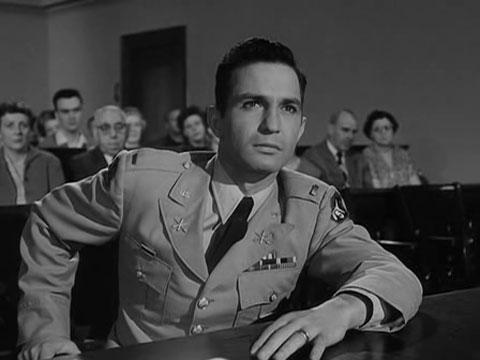
Biegler may be small-town, but he's got the experience. The man he is defending is army Lieutenant Frederick Manion, played by the recently deceased Ben Gazzara, who has just killed a man named Barney Quill. Manion, who openly admits that he killed Quill, says he did it because Quill had raped his wife, Laura (Lee Remick), hours earlier. Laura backs the story, and Biegler agrees to take the case, recruiting the help of his friend and colleague, Parnell McCarthy (Arthur O'Connell), an old has-been lawyer who has a penchant for the drink.

Like all courtroom dramas, one of Anatomy of a Murder's primary themes is legal ethics. Is murder justified if it is in retaliation of rape? Legally, it isn't, but it is when the suspect suffered from temporary insanity while he committed it, which is the story that Manion goes with. Biegler never questions the authenticity of Manion's story,  that's not his job -- his job is to get him acquitted. But Biegler isn't devoid of ethics or morals, proven when he warns the Manions right before the trial, "Now when you get up on that stand, I want you to tell the truth. I don't want you to tell anything but the truth, don't try and lie, don't try and conceal anything, or you'll get skinned alive."
Jimmy Stewart, right, arguing with Brooks West, with
George C. Scott observing in between.

Twists, turns and surprises will abound in any good courtroom drama, and Biegler's first surprise comes at the start of the trial, when the local D.A. Mitch Lodwick (Brooks West) announces that he will be assisted in the case by hotshot assistant Attorney General (Scott), who came all the way up from Lansing due to the "peculiar nature" of the case, according to Lodwick.

The trial starts, and as witness after witness is sworn, questioned and occasionally bullied, we watch Stewart and Scott go to work. They play off each other extremely well, with Stewart's witty, passionate bordering on temperamental demeanor versus Scott's even-keeled, efficient, yet equally as witty demeanor. Both actors give the utmost credibility to their characters, which in turn makes the viewer eager to see the strategies that both men employ and improvise throughout the case.

The prosecution tries its hardest to keep the motive of the murder, which was the alleged rape, away from the murder trial, but Biegler argues that his temporary insanity plea is contingent on the rape, and thus, its involvement is necessary. After deliberation, the judge, played affably by Joseph Welch, agrees, which helps muddle things up even more. From there, more twists and turns develop, which culminate in the final verdict.

I said earlier that Stewart plays his character with a little more grit than we may be accustomed to, but the Stewart of old is still there, and he still posseses that warm twinkle of amiability as his character occasionally goes off on dull but humorous tangents, like, for example, his love for fishing.

Ben Gazzara as Lt. Frederick Manion.
But it isn't just the Stewart and Scott show. Gazzara plays his part coolly, portraying Manion as a hotheaded yet collected tough guy who could lose it at any minute, and Remick plays Laura, the vulnerable seductress, with just the right amount of promiscuity. Welch is surprisingly one of the more enjoyable characters, eloquently and deliberately reciting his lines with the right blend of ardor and austerity. And finally, Arthur O'Connell embraces his role as the alcoholic sidekick in search of redemption. The film garnered seven Academy Award nominations in 1960, three of which were acting nominations, for Stewart, Scott and O'Connell, respectively.

There are no protagonists or antagonists in Anatomy of a Murder. Each character has their own shades of black and white, but like the color of the film itself, each lies within the shade of grey in the moral color spectrum. In the trial, each character has their own job and agenda, and each do it admirably. At two hours and forty minutes, the film is long, but one should expect it to be, for to dissect the anatomy of a murder is surely no quick task.

~ Review by Ddubbs
Wednesday, February 15, 2012

We Need to Talk About Kevin (2011)

We Need to Talk About Kevin throws away all social etiquette and explores a regrettable, yet real, aspect of our world: school shootings. As touchy a subject you can get, the film sensitively explores how such evil can eventually come to be, and how it is derived.

The film's first five minutes, which are a prelude to the actual story arch, aim to set the mood of the film. The main subject of the film, Eva Khatchadourian, portrayed by an excellent Tilda Swinton, is standing amongst a sea of people, drenched in a red substance we can only presume is blood. It is a very tribal scene, with crowds chanting, and Eva submitting to the chaos, as she is lifted and passed around by the group of people surrounding her.

And then the story begins. The movie does not draw on any real-life occurrences, and is actually based on a 2003 book by Lionel Shriver, and adapted to the screen by director Lynne Ramsay and Rory Kinnear.

The first fifteen minutes fiddle around with time a bit, as the story weaves in and out of two time periods: before the killing spree, and after. Naturally, everything is different in the two scenes. Eva's demeanor, haircut, and even her house represent drastic differences, and it's our job to wait and see how point A gets to point B.

The story does revolve around a high-school killing spree, but I did not misspeak when I said that the main subject of the film is Eva. It is her son, Kevin (portrayed by three actors, Rock Duer, Jasper Newell, and then Ezra Miller), who does the evil deed, but the purpose of the movie is about the mother who raised him, and how her life is thrown into a tailspin upon such evil.

It is a rarely explored subject, because high-school shootings are so villainous, so incorrigible that our minds can't even fathom such maliciousness. It's only human to think that individuals who undertake such a deed must have spawned straight from Hell. However, it's not the case. Not at all.

Tidla Swinton with young Kevin, played by Rock Duer.
Eva is married to Franklin (John C. Reilly), who for lack of a better word, are lovely people. The couple have their first child, Kevin, and devote themselves to him, as any good parents would. But right away, we are made aware of the fact that something isn't quite right with Kevin; he's just a little bit off. However, in the age of social disorders, his abnormalities are constantly dismissed.

We follow the family, and since we know the outcome, we are ever so observant of Kevin's behavior. We watch everything; what he says, his facial expressions, his actions, as we try to look for some type of foreshadowing for what we know the final outcome will be.

The couple has one more child along the way, Celia, played by Ashley Gerasimovich, who is perfectly pleasant, leading us even more to believe that Kevin is an anomaly in this all-American family. Celia, who is cute and friendly, is the child that Eva and Franklin always wanted.

But let's talk about Kevin. I said earlier that we look for the signs of inherent evil within Kevin. But instead, he's the opposite. To put it eloquently, Kevin is simply cool. Good-looking, smart, eloquent; on paper, Kevin seems like a parent's dream. However, he still possesses that air throughout that tells us that something is a little off, and that is a tribute to the acting of Miller. He plays the part pretentiously (in a good way), with just the right blend of coolness and malevolence.

Tidla Swinton, meanwhile, is phenomenal, as she goes beyond the realms that any parent would ever wish to go. One can't even begin to imagine what it must feel like to have your own offspring commit such a heinous crime, but Swinton's acting certainly gives us a little bit of insight. Franklin may adore his son, but Eva is the only one who actually fears Kevin, and has the intuitive sense that he may actually be capable of doing terrible things.

Ezra Miller in We Need to Talk About Kevin.
At one point, she discovered a compact disc in Kevin's room. Curious, she loads it onto her computer, only to discover that the disc contains a virus that, when inserted, will wipe out your entire hard drive. Why do you possess such a thing, she asks. "What's the point?" The camera then zooms in directly on Kevin's eyes, and he recites a response that gives us as much insight into his character than any other dialogue in the entire film:

"There is no point. That's the point."

Even though we know how the movie will end, the characters become so compelling that we almost will ourselves to think that the ending will be different. We hope that Kevin will change his mind, but deep down, we know he won't. And when the deed finally does occur, the faint-of-heart and easily-saddened need not worry. Nearly all of the violence takes place of the screen, and is implied rather than shown. But it does happen.

Although the plot is drawn out for us right from the get-go, the movie explores the psychological nature behind the people who commit one of the most unspeakable actions one could imagine, and shows us how the events come to be. It is a character study through and through, and there's no doubt, when the film ends, you know exactly which character you will be talking about.

~ Review by Ddubbs