Showing posts with label Steven Spielberg. Show all posts

Wednesday, February 29, 2012

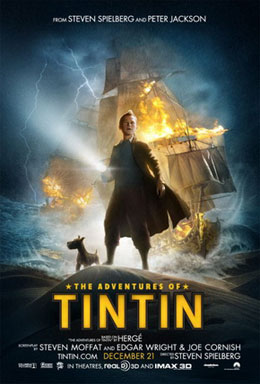
The Adventures of Tintin (2011)

Before he died in 1983, Belgian writer and artist Georges Remi developed a friendship with movie director Steven Spielberg. After the befriending, Remi publicly stated that if his comic, The Adventures of Tintin were to ever be adapted to the big screen, that Spielberg would be the ideal filmmaker to spearhead the project. Twenty-eight years later, Spielberg abided.

The Adventures of Tintin is a comic that first appeared in a Belgian newspaper in 1929. Since then, the series evolved into 24 books, with publication dates ranging from 1929 to 1986, which have been translated in over 50 languages and have sold over 200 million copies worldwide. So it wouldn't be surprising if Spielberg felt a tiny bit of pressure when creating the first film adaptation of the story.

Spielberg and Peter Jackson signed on to co-produced three Tintin films, and used Jackson's company to provide the animation and special effects. The story they chose to start with was "The Secret of the Unicorn," which was published in two parts by Remi in 1942 and 1943.

The stories, and Spielberg's subsequent film, revolve around Tintin, a reporter who has a thirst for adventure. He is young, wide-eyed and brave, and never turns down an opportunity for a good story. His reporter-like curiosities in his vocation have led him on a myriad of adventures, and are the impetus for all of the Tintin tales. "The Secrets of the Unicorn" is no exception.

First and foremost, let's just say that the animation in Spielberg's The Adventures of Tintin is nothing short of stunning. There's no question that animation has evolved over the last decade, but never before has it looked more realistic than it does here. Naturally, the human beings still look clearly animated, but the scenery in the film, and the background props -- bookshelves, tables, lamps, etc. -- look genuinely real. Welta Studios, Jackson's company who created the animation, have also done the effects for other visually-stunning films, such as the three Lord of the Rings films, King Kong and Avatar. But this may be the best animation yet.

Anyway, the film wastes no time jumping into the action. We meet Tintin, who is voiced by Jamie Bell, accompanied by his faithful dog, Snowy. He is at an outdoor fair somewhere in Europe, and his eyes immediately become attracted to a model ship, called the Unicorn, that is being sold at a booth. Tintin makes the purchase, and immediately is confronted by a man named Ivan Sakharine (voiced by Daniel Craig), who wishes to buy the ship from Tintin for an outstanding price. Using his keen sense of intuition and adventure, Tintin refuses to sell it. He's immediately warned by Sakharine that the ship will only bring him trouble, but knowing Tintin, that only fuels his interest.

Haddock, Tintin and Snowy in The Adventures of Tintin
Shortly thereafter, Tintin's apartment is ransacked and the ship is stolen. Being the astute reporter he is, Tintin immediately embarks for the local public library, where he looks into the history of the actual ship, the Unicorn, only to learn that there is, of course, a story behind it. Many years ago, the ship set sail on a voyage, only to never return.

Tintin's continued digging puts him right in the heart of the adventure. He teams up with a ship captain, named Haddock (voiced by Andy Serkis), who has his own motives towards the adventure, to discover what happened to the Unicorn on its fateful voyage many years ago.

The Adventures of Tintin is for the the young-at-heart, enthusiastic adventurists who have always dreamed of embarking on their own journeys to solve an epic mystery. I wouldn't necessarily say that Tintin is a a kids' movie, but there's no doubt that children are one of the target audiences, and therefore you must bear with the film a little when the action becomes a bit outlandish and unrealistic. When that happens, just absorb the amazing visuals that Spielberg and Jackson present to us. Also, the dialogue is funny and endearing enough to appeal to all ages.

Of course, as the plot thickens, mysteries will untangle , formidable foes will step in Tintin's way, and unexpected allies will come to his aid when he needs them most. That is what adventures are all about, and this story has them in spades.
Tintin holding a cartoon depiction of himself, as
he is portrayed in Georges Remi's original comics

Spielberg of course pays homage to the original writer, Georges Remi, who went by his pen name, Hergé. In the opening scene of the film, Tintin is being drawn by a cartoonist, who is meant to be the actual Georges Remi, and the resultant drawing is a depiction of the original cartoon Tintin. Additionally, other characters who were staples in Remi's popular books make appearances, like the incompetent detectives, Thomson and Thompson (voiced by Nick frost and Simon Pegg, respectively.)

With The Adventures of Tintin, you will see the world. You'll watch as Tintin and Snowy sail across oceans, walk through deserts, run through cities, and fly through the skies. From start to finish, the animation will amaze you, and Tintin's wide-eyed hopefulness will inspire you. No doubt, Georges Remi did indeed pick the ideal filmmaker to bring his timeless stories to life.

~ Review by Ddubbs

Friday, January 13, 2012

War Horse (2011)

There once was a day in film when epics reigned supreme. Movies would typically last an excess of two hours, bordering on three, or more. But now, in an age where people seemingly wish to be entertained in the minimal amount of time as possible, epics have become prehistoric. And that is why Steven Spielberg's epic World War I drama War Horse has not been getting the proper buzz and acclaim that it should be. What a shame.

Steven Spielberg has already mastered World War II in film, with his 1998 masterpiece, Saving Private Ryan. This time, Spielberg goes back two decades and takes on World War I. Like Ryan, Spielberg does not focus on the war as a whole, but picks a story within the war as his focal point, with the purpose of entertaining, horrifying, and to tug at your heartstrings.

Having now shot two war films, one may be inclined to think that Spielberg's own personal depiction of war should play a part in both works; but it doesn't. He doesn't judge, or criticize, he merely gives us a realistic presentation of what war is: a brutal and irrational, yet effective, means of getting things done.

War Horse, based on Michael Morpugo's 1982 book, and a 2007 stage adaptation, gives us the ultimate tale of devotion. The story centers around a struggling English family, the Narracotts, headed by Rose (Emily Watson), Ted (Peter Mullan) and their teenage son, Albert (played by Jeremy Irvine in what was essentially his major motion picture debut.) As one may perceive from the trailer, the family purchases a horse, named Joey, of which Albert forms the deepest of affinities with.

Joey not only bonds with Albert, but saves the family from poverty and foreclosure as Albert goes against the odds and teaches the thoroughbred how to properly plow a field.

But then the first half of the title comes into play. The arrival of World War I coincides with the Narracott's crops being destroyed by heavy rains. Desperate, and left with no choice, Ted sells the horse to an English captain (Tom Hiddleston) for the war. Albert is distraught, but by the time he finds out what is happening, it is too late; Joey has been sold. But not before Albert  -- too young to volunteer at the time -- makes one more final pledge to Joey that, when all is said and done, the two will reunite.

 "This isn't the end. This isn't the end, my brother. I, Albert Narracott, solemnly swear we will be together again. Wherever you are, I will find you. I will bring you home." 

It's impossible isn't it? Locating a single horse among hundreds of thousands, deployed somewhere across Europe. And yet, with the deep conviction in Albert's voice, we can't help but to believe him.

A fantastic score by the one and only John Williams enhances the emotions throughout the film, but it is not necessary. The acting, across the board -- amplified by Spielberg's visuals -- is top notch, and need no aid as far as providing emotion.

And with that, we follow Joey. Changing hands constantly throughout the war, and to both sides of the fight, among them being Hiddleston, two German teenagers (David Kross and Leonhard Carow), and a French girl and her grandfather (excellently portrayed by young Celine Buckens and Nierls Arestrup). And with each new possessor, we learn their story, and how the deadly war has affected their lives. With each character's tale, we wonder more and more why this great war is happening if it hurts everyone who touches it.

Celine Buckens in War Horse.
Again, Spielberg is not being critical. There is one terrific scene, where an English and a German soldier cross into no man's land to work together. Away from the bullets and the trenches, they are just two young men, joking around, and getting along despite the fact that they are supposed to be enemies. Not one scene conveys the irrationality of war better than that one.

With magnificent cinematography, Spielberg gives us the horror of war, putting us right in the heart of the battle. It's not quite as graphic as Saving Private Ryan, and I think I'm correct in thinking that was his intention. Whereas Ryan would be better off not being viewed by a young audience, War Horse is a great introduction to war for young teens. Because amidst the storyline of a young man and his love for his horse, which a younger audience can relate to, there is a war going on.

All the while, Albert, who eventually becomes old enough to volunteer, is still on a quest for his horse. Whether he will find him remains anyone's guess up to the film's end, as most people know that Spielberg has never been one to submit to fairy tales.

In the two hour and twenty minute saga that Spielberg gives us, your emotions will be taken for a ride. Aside from your attachment towards the love between Albert and Joey, you will feel for every character that sets foot on the screen. And in a war movie, you know where that leads.

It all stands to reason why Spielberg enjoys picking subplots within wars to tell his story. It mostly involves young men who get mixed up in something in which they have no idea why they are involved with in the first place. Yet, it takes everything from them and gives them nothing in return. And that is the unforgiving nature of war. We don't sympathize for the political leaders who set the war in motion, but for the young soldier, who just wants to live, go home, and find his beloved horse.

~ Review by Ddubbs