Showing posts with label foreign film. Show all posts

Wednesday, June 20, 2012

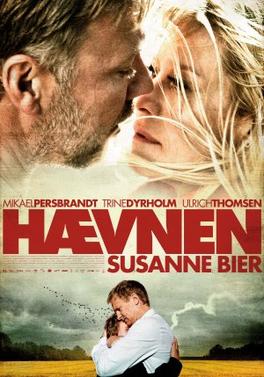
In a Better World (2010)

Just before the midway point of In a Better World, a father, named Anton (Mikael Persbrandt) sits with his son Elias (Markus Rygaard) on a bench in their backyard. Elias asks his father if he intends to enact revenge on a man who humiliating him by slapping and cursing at him in public.

"You don't go around beating people up. That's not the point," Anton says to his son. "What kind of world would we live in then?"

Although Anton tries to preach idealism to Elias, the fact of the matter is that there is too much negativity out there to skew his perception. Anton works as a doctor in a Sudanese refugee camp, and is exposed to the atrocities that the Sudanese people endure through disease, and namely, heinous and violent crimes that they commit on one another. Anton understand the malice in the world, and you can see it's with a sense of halfheartedness that he tries to keep his son innocent.

In a Better World is a Dutch film directed by Susanne Bier. The film is seen through the eyes of Anton, Elias, and a boy named Christian (William Johnk Juels Nielsen), who Elias befriends at school.

Bullying is a recurring theme in the film. It starts out on a smaller scale, with Elias being bullied by a fellow student, and then escalates when we watch Anton manhandled by a another father (Kim Bodnia) at a park after he tried to break up a scuffle between their infant children in the sandbox. But then we see it on possibly the most heinous scale, when Anton faces a moral dilemma at his refugee camp after a known war criminal comes in seeking aid on his injured leg.

Anton is married to Marianne (Trine Dyrholm), but the two are separated and contemplating a divorce. As if that wasn't enough negativity for one movie, Christian's mother has recently died of cancer, and as a coping mechanism, is irate at his father (Ulrich Thomsen), claiming that he "didn't do enough" to save his mother.

Markus Rygaard, left, and William Johnk Nielsen.
Dealt with bullying, divorce and death at such an early age, the movie serves to show how two children, Christian and Elias now view the world after they have experienced this loss of innocence. Instead of playing sports and watching television like any adolescent boys, the two children sit atop of silos, staring at the skies and wonder how their worlds fell apart. Having been faced with adversity, they handle it differently, and things take a turn when Christian convinces Elias to take a violent approach in order to start getting the things they want. But after what they've experienced, it's hard to blame them for not knowing any better.

The film is beautifully shot by Bier, who also wrote the story with Anders Thomas Jensen. For such an ambitious task -- attempting to encapsulate the loss of innocence among two young children -- the material is handled delicately and beautifully. The film tried to capture, in my opinion, almost what Terrence Malick's The Tree of Life tried to capture, but in a much more linear and focused way.

The acting across the board is sensational as well, primarily between the three main characters, portrayed by Persbrandt, Rygaard and Nielsen, but it is the latter who impresses the most. How he manages, as Christian, to shield off all emotions and make his character seemed deadened to the world is almost frightening to see.

Though it is littered with sorrow, the film doesn't aim to be cynical, but hopeful. Just like with Anton's preaching to his son at the middle of the film, it tries to teach us that although acts of kindness may not be rewarded as they should, that they are still the right way to life your life if you one day wish to be living in a better world.

~ Review by Ddubbs

Wednesday, June 13, 2012

The Kid with a Bike (2011)

Sometimes it is the simplest tales that evoke the most emotion. Stories of rare individual triumphs or catastrophes can certainly lead to a few tears, both happy or sad, but it is the situations in which we can relate to that truly make us feel something.

The Kid with a Bike (2011) is directed by Belgian brothers Jean-Pierre Dardenne and Luc Dardenne. The principle language of the film is French. The story revolves around a 12-year old boy named Cyril, played by Thomas Doret, who is in foster care. His father has abandoned him, and his mother is out of the picture for unspecified reasons. But all that matters is that he has no one.

Cyril leaves his foster home and goes looking for his two most treasured items -- his bike and his father. But he soon discovers that his father's apartment is empty, meaning that he has moved on with his life without so much as a goodbye. He finds his way into the a store of a hairdresser named Samantha, played by Cecile de France (Hereafter) who takes a liking to young Cyril. Shortly after, Samantha delivers his lost bicycle to him, informing him that she bought it off another child. Cyril asks Samantha if he could stay with her on weekends, and she agrees.

Even though he has found a loving caretaker, Cyril still desperately wants to see his father. Understanding this, Samantha takes him on a quest to find him, only to discover that his father (played by Guy Catoul) wants nothing to do with him. He tells Cyril and Samantha, quite simply, that he can't handle the responsibility of being a father.

Already a temperamental adolescent, Cyril becomes inconsolable, and finds himself in a vulnerable state in his life. Riding around streets on his bike without supervision, he finds a new friend in a young gang leader (Fabrizio Rongione) who is nice to Cyril. He offers him drinks, money and lets him play video games. But in reality, he's trying to recruit Cyril, a naive youth, to do his dirty work.

It's a prime example of how a young child can easily fall through the tracks. Parentless and rejected, he is simply a young boy looking for attention. Although Samantha loves him, and treats him like her own son, she is still not his a biological parent.

The film is shot in a very naturalistic style, almost as if it is a handheld camera. There aren't many characters, and Cyril and Samantha dominate the screen. The film conveys the bond that begins the form between the two, and the sacrifices that Samantha must make to consider herself Cyril's primary caretaker.
Thomas Doret and Cecile de France

But the mood of the film is hopeful. It shows that just because you do not have a traditional upbringing, that it does not mean you still can not have a good one. It preaches resilience, understanding and acceptance. The Kid with a Bike is a very real film about real situations, and a film that tells us that we need to not necessarily avoid making mistakes, but to learn from them.

The acting across the board is fantastic. Doret and de France share a wonderful chemistry that only adds to the realism. The two also do a superb job hitting home the emotions of the film, which become heavy at times. Although music is not heard often in the film, when it is, it is powerful at just the right moments.

The Kid with a Bike will certainly not be one of the most unique or original pieces of cinema that you've ever seen, but it flourishes on telling a simple story that many people will find no trouble relating to.

~ Review by Ddubbs

Monday, June 4, 2012

Once Upon a Time in Anatolia (2011)

A group of men venture out into the Anatolian steppes in search of a dead body. On the surface, that plot synopsis reads like something that would make fans of big budgeted action-adventure movies gush, but in truth, Once Upon a Time in Anatolia is an intense character study full of deep philosophical subjects that foray deep into the human psyche.

It's a windy, sometimes rainy and thunderous night in the grasslands of Turkey, far removed from civilization. The two murder suspects have already been apprehended, but one, Mukhtar (Ercan Kesel) is mentally ill, and the other, brother Kenan (Firat Tanis) is slow-minded and was intoxicated at the time of the burial. That's not a good combination, and the result is an all-night search party that elapses into the following morning.

The group is full of doctors, lawyers, militia, grave diggers and policemen, but only three of them matter to us. The three prominent men are grizzled veterans of their crafts, middle-aged and have long been desensitized to the ill-conceived acts that human beings are capable of. One is prosecutor Nusret (Taner Birsel), another is police commissioner Naci (Yilmaz Erdogan), and the other is Doctor Cemal (Muhammet Uzuner).

The three men are simply known by their titles and their last names. It's all you need to know because it is what they have become after years of honing their crafts. All three were married at one time, and two ended unhappily. As three battle-scarred professionals, the men respect each other, and throughout the night they talk about various topics, both work related non-work related, which range from death, marriage, politics to even lamb chops. Some scenes depict characters going off tangents concerning these topics, while the camera shows wide-angle shots with the speaker not even on screen, showing that it is the words, and not the speaker, that are crucial.

Though they are searching for a body, the men are really looking for something much deeper in their lives -- meaning. In between the conversations, they stare longingly into the night, the moon reflecting their faces, revealing lines and creases that can only come with the trials and tribulations of every day life. It is these scenes, which tell us what the characters don't say rather than what they do say, that are the most revealing.

Directed by Nuri Bilge Ceylan, the film is beautifully shot, contrasting closeup shots of the weary characters with the wide Turkish landscapes. The isolated, barren scenery corresponds perfectly with the mood of the film, which is introspective and unfulfilled.

The group of men searching for body in the Turkish steppes
The script, penned by Ceylan, Ebru Ceylan and Ercan Kesel cleverly manages to weave mundane talk with deep philosophical musings, accomplishing this by using metaphors and prolonged conversations. The film tackles all the subjects that every human being ponders throughout the course of their existence, without delivering any real answers. The actors are all superb, which is impressive considering their lack of experience. Not that one would expect many Turkish actors to be household names, but checking their resumes, it doesn't appear that many of the actors in the film had an extensive film career beforehand.

Once Upon a Time in Anatolia will cause viewers to ponder the meanings of their own lives, and what exactly it will take for them to find satisfaction. In the film, the three men have gotten close to the top of their respective career paths, but still seem like they are simply going through the motions while they work. Rarely, over the course of their near 18-hour search party to do they complain, and that's because they all knew what they signed up for when they chose their line of work.

The search for the body becomes a little less relevant as the film progresses -- called it a "McGuffin" if you will -- but with the aforementioned clever script, the investigation does manage to come home in the end and tie into the movie's primary themes. Once Upon a Time in Anatolia is indeed an example of great storytelling, but the furthest thing from a fairy tale as the title of the film suggests.

~ Review by Ddubbs