Wednesday, January 11, 2012

Real Steel (2011)

Upon viewing the trailer for Real Steel, one may be inclined to shudder, followed by the thought that this is just another robot-action, CGI-laden project trying to cash in on the commercial success of Transformers. I'll admit it, I did. But then you watch the movie, and you realize that Real Steel has something else, something deeper than your typical action flick: heart. And when it comes down to it, it's really a feel-good sports movie, and not much different, then say, Ron Howard's 2005 boxing hit, Cinderella Man. Except with robots.

Shawn Levy's Real Steel takes place in the "near future," where boxing as we know it has become obsolete, and instead of humans as fighters, they've been replaced by giant robots controlled by humans. And savvy-sports followers can think back to the state of boxing thirty or forty years ago, and compare it to the state of boxing now, and acknowledge that this isn't really all that hard to fathom. In fact, reports have surfaced that Floyd Mayweather had recently called out Manny Pacquiao -- the top fighters of our current generation -- via Twitter. Need I say more?

Anyway, let's get back to the film. Real Steal begins with an opening sorrowful tune in the form of Alexi Murdoch's "All of My Days," which instantly gives the viewer the impression that they are supposed to feel something. However, just minutes into the feature, and with a distant shot of a single car driving down a desolate road at dusk, we are not sure exactly what.

Levy is no stranger towards directing big movies with star actors and high expectations, as he is noted for directing both Night at the Museum films. Directing a low-budget indie film is one thing, but directing a "blockbuster" is another, and Levy seems to have honed down whatever it takes to do so, even managing to navigate Real Steel away from typical blockbuster tricks (explosions and fights) and steering it more towards a character drama.

Although, there is no questioning that the film uses conventional clichés to further the plot. The lead character, Charlie Kenton, portrayed by Hugh Jackman, is a rude, selfish, greedy and underachieving middle-aged man, who finds his world changed when news is delivered that his ex-girlfriend suddenly died. Additionally, she left behind a son, which conveniently, is his.

The son, whose name is Max, played by a young man named Dakota Gayo, is astonishingly not at as mad at his father as he should be, considering he abandoned him for 11 years. However, the plot goes on. Charlie, who remember, is selfish and rude, and unequipped to be a father, uses the situation to his benefit. His deceased ex-girlfriend has a sister, Debra (Hope Davis) who is married to a rich man, Marvin (James Rebhorn), who wish to adopt Max. Charlie swindles a deal with Marvin, unbeknownst to Debra, to relinquish custody to them for a large sum of money. Everybody wins! Except Max, of course.
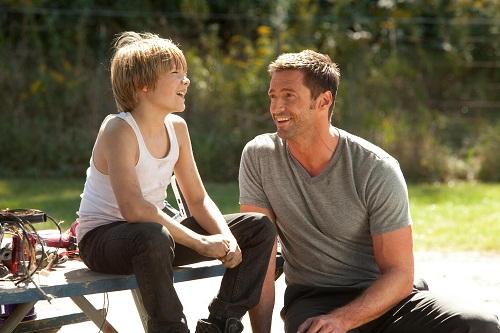
Dakota Gayo and Hugh Jackman bonding.
As his means of living, Charlie, once an acclaimed boxer, maintained the lifestyle and now spends his time designing robots, hoping to create one that could earn him big money, and garner the success that he never experienced as a boxer himself. He works with his friend/girlfriend/hook-up buddy (the history of their relationship is never delved into -- though by the end there leaves no question as to what they are), Bailey, played by Evangeline Lily.

However, the one catch to Charlie and Marvin's deal (conveniently, for plot's sake), is that Charlie must look after Max for two months while he and Debra are vacationing in Italy. Luckily for Charlie, Max shares a fascination with robot fighting, and joins him in his escapades.

And finally, Real Steel takes off. Charlie and Max begin to bond, and eventually, learn from one another. Whereas Charlie wants to assemble an almighty robot that will win him the most amount of money, Max just wants to find a robot that they could call their own.

Atom, the underdog robot in Real Steel
They finally find it when, while searching a junkyard for parts, Max stumbles upon (literally) a discarded robot named Atom. It's an "older model," explains Charlie, and a "model that stands no chance in the ring against real competition." And that's when the underdog story comes into play. In that regard, Real Steal is not unlike such classic underdog tales as the aforementioned Cinderella ManRudy (1993), or Hoosiers (1986). Like those movies, the lesson of Real Steel teaches us that you don't need to the biggest and strongest, or the fastest, but you need to have the most motivation, determination, and the most drive. How can you not take kindly with such a message?

Charlie and Max start out at the bottom with Atom, but after winning a few spars, finally make their way into national attention, working their way into the professional circuit to square off against the big boys, er, I mean robots.

While the robots in the films are not meant to have a personality, Atom does, as he seemingly has some type of kindred connection with Max, allowing the viewer to empathize with the pair even more. Hugh Jackman, meanwhile, does what he does best, portraying the rugged, masculine protagonist who doesn't take crap from anyone. But Jackman's chemistry with young Dakota Gayo, who gives a fairly impressive performance for a child actor, is what makes makes the film work on certain levels. Gayo, whose character clearly inherited an attitude from his father, goes back-and-forth with Jackman with ease throughout the movie.

Though the film takes place in the future, the film doesn't try to overshoot the advancement of technology, aside from the giant fighting robots. Computer screens and phones sure do look a lot more high-tech, but other than that, the film may as well have taken place in 2011.

Like all underdog stories, the film predictably culminates with one big fight, and despite the corny dialogue and conventional plot elements, you won't be able to stop yourself from rooting for Atom -- and Charlie and Max -- with all of your heart.

~ Review by DDubbs

Tuesday, January 10, 2012

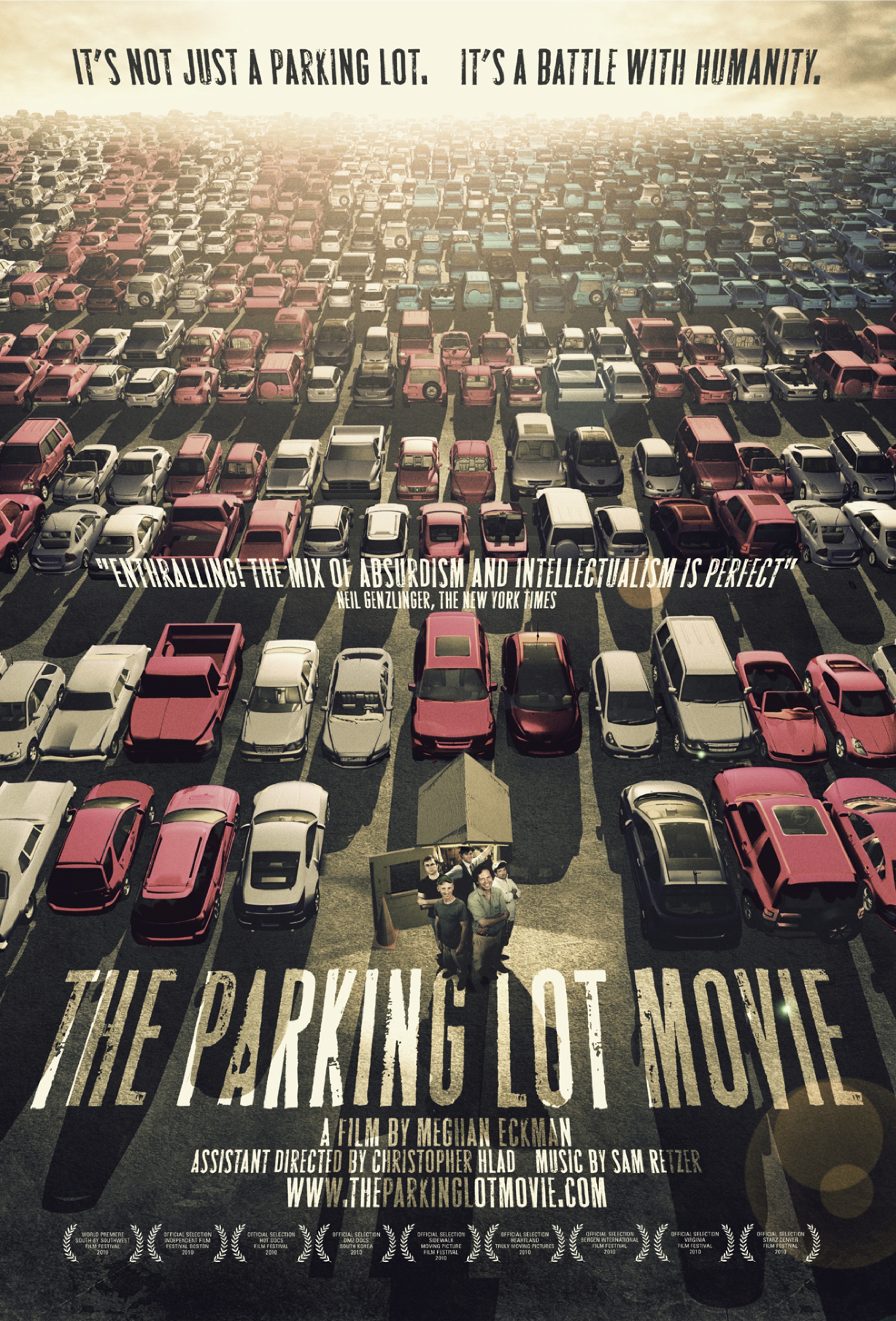
The Parking Lot Movie (2010)

I only came across this movie because Jon Wurster (drummer of the indie rock band Superchunk and WFMU radio personality) tweeted about it.  A combination of his infatuation and its intriguing title left me with little choice but to watch it.  As a result, I now find myself discussing the triangularly shaped slab of pavement flanked by the backs of restaurants and train tracks situated in Charlottesville, Virginia.

Home to the University of Virginia, the Corner Parking Lot (CPL) employs, services and is often vandalized by constituents of its student body.  The documentary, directed and edited by Meghan Eckman, consists mainly of interviews of the lot's past and present attendants.  Eckman uses some effects like title shots (here and there a ridiculous quote by one of the many eclectic employees), quick zooms to accentuate quirky lines or awkward moments, and tons of stills of the booth's storied paraphernalia.  It's the wacky philosophies and the quirky/nerdy/awkward/brilliant personas of those who have had their hand in the operation of CPL, however, that make this film the charming, straight-up served dish it is.

Early on, we are introduced to Chris Farina, CPL owner since 1986.  Farina, we learn, gained an appreciation for personal interaction with the consumer during his travels while a youth.  Usually reclining or laughing at his own answer, Farina comes across as someone who has got the proverbial "it" figured out.  He mentions at one point he's more concerned with the employees than the customers in his lot, a tribute to his employees' almost filial regard of him.  He is laid back, down-to-earth, and content.  In some ways he reminded me of Anthony LaPaglia's music store manager character in the 1995 feature film Empire Records.  The employees' camaraderie and buoyant repartee among each other in the Allan Moyle directed film also falls in line with that of the CPL.

Chris Farina, owner of the Corner Parking Lot, in the booth.
But the real backbone to The Parking Lot Movie is the employees themselves.  From offering exaggerations ("the kind of building Jesus would've collected parking fees from") to existential toss ups ("you're in the cage...or they're in the cage?") we come to understand what it means to be an employee at the CPL.  There is the general abhorrence of the customers who are said to exhibit a "smug entitlement".  There is the appreciation of being paid to sit in a space all to yourself while mostly doing nothing.  And there is the broad consensus that at some point every one of the employees finds despair and verges on insanity as a hazard of the profession, which even Farina alludes to.  The many shenanigans and customs that embody the CPL employee spirit could propagate paragraphs more of discussion but that's where watching the film yourself would come in as a much better option.

One last point that is essential to address is the film's tone toward its subject-matter.  Would I call The Parking Lot Movie a mockumentary?  Not for a second.  Although plenty of dialogue was kept and edited for tongue-in-cheek purposes, and the music (done by Sam Retzer) certainly pokes fun at points, it is clear that a full out parody is not what Eckman set out to make.  On the contrary, what one should take away from the movie is its sincere message that these employees all look favorably on their time spent at the lot.  As one worker states, during their employment " [we] had it all in a world that had nothing to offer us."  While acknowledging and often times deprecating over the trivial part of society they play or played a role in, they all betray, consciously or not, a sense of satisfaction and dare I say gratitude for their time spent at the Corner Parking Lot.  In the end, we're taught two invaluable lessons: the first in vocation, humility and appreciation; the other in how a small to mid-size urban pay parking lot works.

~ Review by Mike Dorfman

Milagres - Glowing Mouth (2011)

Let me preface this review by saying that I have never written a musical review before, nor I do really read musical reviews. I am, however, always downloading new music and searching for new bands that I can enjoy. By doing so, I'd like to think that I have developed somewhat of a decent taste when it comes to quality music. Therefore, my goal is to simply bring these albums to light, while sharing in "layman's terms" as to why I think this band and/or album may be listenable. So, let's give this a shot.

Anyway, I have no idea what "Milagres" means. If anything, it actually sounds like a Spanish term. Maybe it is; who knows. However, upon my initial listen, I was instantly reminded of My Morning Jacket. Lead vocalist Kyle Wilson has a very melodic tone, not unlike Jim James, and is able to hit the high notes and low notes with ease. He doesn't try to outshine the music, rather, he uses his voice as a tool, and you almost forget it's there, as you allow yourself to be pulled into the smooth sounding docile tones.

Some songs did speed up a bit, and my favorite track, "Gentle Beast" sounded like it could easily have been a song by Arcade Fire. In fact, if I listened to it for the first time, and you told me it was Arcade Fire, I'd have believed you without question.

I like to judge an album by generally placing them in two categories: the first being, is this music I can listen to in any context, whether I'm at work, on a train, or just have five minutes to spare, and could only pick one song to listen to in my entire iPod?

Or is it simply good background noise, meaning that it's not my first choice, but if it were to be on while I was doing another activity, I would enjoy it.

Milagres' Glowing Mouth definitely falls into the first category. I've listened to the album a few times now, and I enjoy it more with each subsequent listen. The entire album flows smoothly, does not let up, and if anything, gains a little more traction during track 8 (of 10), "Gone," which I'd classify as my second favorite song on the album.

Despite the earlier references, I don't mean to compare Milagres with My Morning Jacket and Arcade Fire, however, if you're a fan of the latter two, then I truly believe you will enjoy Glowing Mouth. Or if you're just a fan of quality, clean, indie rock, then I highly advise that you give it a shot.

~ Review by Ddubbs

Saturday, January 7, 2012

Underworld (2003)

Believe it or not, on Jan. 12, a fourth installment of the Underworld series will be released. For a film to release a sequel, let alone three of them, it means that the series must be a critical and commercial success, it must be in the hands of capable actors and filmmakers, and probably most importantly -- it must continue to appeal to its target fan base.

Having never bought into "the great vampire craze" of the mid-to-late 2000s, I avoided this movie, until recently. Although, to be fair, one can make the argument that Underworld beat the new found vampire phenomena to the punch, having been released before other notable films and franchises of the same genre, including Van Helsing (2004), Let the Right One in, Twilight and True Blood, the latter three which were released in 2008.

Regardless, once a film series reaches its fourth installment, it intrigues me enough to want to discover what the fuss is all about. So let's get into it.

Underworld, like most fantasy-based films, comes down to one single fundamental argument, which has existed since the dawn of time: Is one ethnic group -- or in this case, species -- better than the other? Regrettably, this has been a theme in the history of our world, and resultingly, has given us tragic events such as slavery, the Holocaust, the Trail of Tears, and the list goes on. Underworld takes on this question in another form: vampires vs. werewolves (or Lycans, as they are coined in the series.)

Like all ethnic wars, no one really remembers why they hate each other, but they just know that they do. It's why they live: to fight this war, even if the origins are long forgotten.

Kate Beckinsale takes the helm as the vampire heroine in this series, and aside from providing the male fan base with an abundant amount of eye candy, takes on the role of Selene in a cool, polished fashion. While one can easily argue that Beckinsale's career relies solely on her looks, there's no denying that she fits the role of Selene so well, that she may have even been a vampiress in a previous life. Although, she doesn't need to do much but look pretty and let her sexy British accent add to her character's intrigue and seductiveness. Indeed, a lack of acting skills may have actually benefited her in this role, as vampires are meant to be devoid of actual human emotion.

Bill Nighy as a vampire elder.
Selene is not the leader of the vampire pack by any means. Though she is respected, and proven, she still is forced to take orders from her clan leader, Kraven (Shane Brolly), who takes his order from his elder, Viktor (Bill Nighy.) In Underworld, the vampire world is very structured.

So why is the narrative centered around Selene, you may ask? Well the answer is, simply, because unlike the other vampires -- she is decent. She alone questions the rationale behind the vampire's 600-year war with the Lycans. Does she still participate? Of course. But reluctantly.

Her doubt is put to the ultimate test when a new species is dragged into the war -- a human named Michael (Scott Speedman.) The Lycans are hunting him for a specific purpose, and Selene is determined to find out why. In the meantime, she takes it upon herself to protect him, going against the will of her vampire kin.

In a way, the film is reminiscent of Avatar, another fantasy flick that incorporates a battle of two species for superiority. When this happens, the chain of events is inevitable. One individual will finally question the rivalry, will form an unlikely kinship with the enemy, and will go against their own species so that they could do what they think is right. Underworld is no exception.

Call it cliché if you will, but Underworld does do a lot of things right. Director Len Wiseman, in what was his directorial debut, headed this project (along with the next subsequent releases before parting ways with the upcoming fourth release), and he clearly had a vision when creating not only a setting of this movie, but a world. Appropriately, given its title, the film is dark -- literally, dark -- to the core. In fact, I can't recall an instance of sunlight at any point during its two-hour length. If you've ever seen Dark City (1998), then think of terms of that. The Underworld that Wiseman created may not be added to your list of possible Honeymoon locations, but it definitely gives the film some character.

The score also fits will. Upon my viewing, I felt like, at times, I was sitting in a Rob Zombie concert. The fast-paced rock and roll sound coincides nicely with the action, further contributing to the film's mood and helps accentuate the film's pacing.

A film like this could also fall into a trap of relying too heavily on CGI. However, the special effects are as believable as a human transforming into a werewolf could possibly be. Also, never mind the classic vampire bites and werewolf attacks, Wiseman's Underworld takes place in the modern age, where guns abound. This is no classic tale, where Lestat creeps up on his prey at the dead of night, this is fighting in the open, with guns, on a subway platform, with humans present.
Why bite when you can shoot?

The film doesn't dumb it down for you too much as the plot develops. You're meant to be in the dark (both literally and figuratively) until all the details are finally shed. You discover why the werewolves are targeting a human being, and through a series of flashbacks, you discover the origins of the vampire versus werewolf feud, which may actually alter your view of who the sympathetic figures of the film are -- clearly the screenwriter's intent. And Beckinsale is helped out in the acting department by some capable veterans, primarily Nighy and Michael Sheen, who plays the Lycan leader with a creepy effectiveness.

An inter-species love story abounds between Beckinsale and Speedman, of course, and as the film resolves, you realize it was clearly meant to be a setup for future films. Call it cockiness, or call it a premonition towards the upcoming "vampire craze" which was still about three or four years away. Either way, I said earlier that for a film franchise to develop, it must successfully appeal to its target audience; well, if you're a vampire aficionado, it certainly achieves that.

Whether three sequels were warranted still remains to be seen, but as a solo project, Underworld has all of the ingredients to appeal to the vampire enthusiasts, while not relying too heavily on age-old vampire clichés.

~ Review by Ddubbs

Friday, January 6, 2012

Happythankyoumoreplease (2010)

For no particular reason other than Netflix instant viewing availability I decided to screen possibly the longest single word titled movie ever.  What I knew going into it was that this was the directorial and screenwriting debut of Josh Radnor (who plays the main character on the hit CBS sitcom How I Met Your Mother).  He also stars in the film, the largest role of his young career (helps to know the director/writer) up to date.  I also knew that there'd be an extremely bald Malin Akerman (27 Dresses, Watchmen) from the advertisements and an interview I read somewhere while probably taking a dump about how difficult it was for her to go hairless.  Anyway, this movie is all story, cliche lines and decent music (not a whole lot done with the camera), so let's get into it.

From the poster art and title font, you knew this was going to be uber-Indie, and if not, you knew it was going to be from Radnor's character constantly open-mouthed Sam's general 30-ish, white guy, disheveledness vibe.  We are introduced to a full screen of Sam's feet as he steps out of bed waking up borderline late on the day of some sort of interview.  We'll soon learn he is a struggling writer in New York who's trying to push his novel - though the film never really goes into much detail about what it is he writes about.  But Sam's world is about to be rocked.  By an orphaned black kid.


Josh Radnor as Sam.

That's going to be Rasheen, played by first-time actor, Michael Algieri.  Through a series of missteps and misunderstandings it happens that Sam takes this eight year oldish child under his wing.  At first he's an inconvenience and Sam will do anything to get him back to the proper authorities, but it doesn't take much screen time till Sam utilizes him as an aide to pick-up a waitress-singer he's had his eye on named Mississippi (Kate Mara).  Eventually, Sam and Mississippi fall for each other and Sam and Rasheen confide that they are best friends with one another.

  
"But it was interesting without eyebrows, when you're in
the shower everything just drips into your eyes and [you]
realize what function your eyebrows actually have."  
            - Malin Akerman                                             

There are two parallel storylines to all of this.  The first involves Sam's best adult friend Annie, played by the aforementioned hairless (and for those who may have put a wager on it, it's alopecia she suffers from not cancer) Akerman. While she is there for Sam throughout the film by leaving ego-boosting revelations on his answering machine (DIGRESSION: Yes we are expected to believe such an antiquated device is still in use during the cellular age.  In reality viewers should note that if it wasn't for the answering machine's incredibly pragmatic cinematic functions, the very knowledge of its existence would cease to be.), Annie has her own issues of self-confidence while being white and 30ish in New York as well.  She's entangled with an asshole ex who hurts her yet another time.  Anyway Sam #2 walks into the rescue, played by an extremely toned down Tony Hale (most notably Buster from Arrested Development).  Usually a character actor, Hale charts unfamiliar territory as a seriously in love co-worker who won't have any if's, and's or but's about whether Annie is going to give him a real chance.

The other storyline is by far the flick's weakest and most unbearable to watch unfold.  Two life-pondering white 30ish New Yorkers (sensing a theme?) in a relationship whine and fight about whether the City holds anything more for them (Charlie, played by Pablo Schreiber, wants to ship out to Los Angeles after a recent invigorating trip out there while Mary Catherine, played by Zoe Kazan, can't bear the thought of ever leaving the homely boroughs).  As their scenes of intense one-on-one conversation play out, the audience is subjected to softly lit close-ups and whispering dialogue.  Whether it was the acting (which surely plays a role in this dysfunctional arc) or the presumably doomed from the start writing, Charlie and M.C.'s sequences feel artificial; like isolated role plays rather than characters with extrapolated lives.

And now for entertainment purposes, some lines from the script that will have you knees on the floor head over the toilet in no time:

"I don't know...I'm just tired."

"I'm so sick of optimism...it's fucking exhausting."

"I've been feeling a little fragile these days, I need you to be nice."

"You're really smart." (genuinely)

"You should trust me...someone has to."

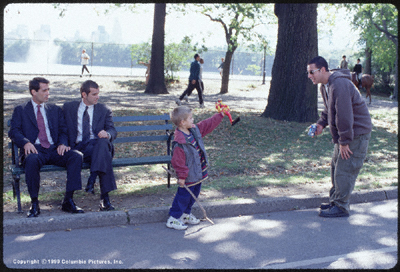
It doesn't matter to which characters these lines belong because if you've caught on to only one thing thus far, it's that all six actors embody the same persona.  At times watching this movie reminded me of sitting through one of those trendy star-studded ensemble romantic comedies that started with Love Actually and has evolved into New Year's Eve.  Only each duo the film jumps to is the same as the last, and each respective member of that duo is the same as the other.  Hellish to stomach, yes.  While we're on comparisons, as a sidenote I would pitch Happythankyoumoreplease as Big Daddy (plot) meets Garden State (tone).  Albeit the successful slapstick and Adam Sandler jokes are non-existent and Josh Radnor is a poor man's Zach Braff while his cronies do not stack up favorably either.
A scene from Big Daddy.

To end on a high note, there is one especially endearing scene while Sam and Rasheen are in the back of a police car.  There's a tremble in Sam's voice and a sense of panic in his actions which come across as refreshingly authentic.  He truly is concerned for Rasheen's future, and with his back against the wall (a nice change of pace from the other 99 minutes of his character coasting), Sam imparts him with advice and whatever wisdom he was able to garner during his days of whatever it is he does to pay the rent.  It's completely unironic, without self-sorrow and a truly heartfelt moment, and for that I'd like to offer Mr. Radnor a "thankyoumoreplease".  If only he had affirmatively answered within the film I could have walked away "happy".

See what I did there?

~ Review by Mike Dorfman

Thursday, January 5, 2012

The Way Back (2010)

Upon my viewing of Peter Weir's adventure-drama "The Way Back," I couldn't help but immediately think of Kevin Smith's ignorant (albeit humorous) depiction of the Lord of the Rings trilogy in his 2006 film, "Clerks II." In the film, his main character, Randall, mocks the epic Peter Jackson trilogy, claiming that "all it was was a bunch of people walking." Bearing that in mind, I can't even begin to fathom what Kevin Smith's reaction to "The Way Back" would be.

In his latest film, Peter Weir takes on a story of magnificent historical ramifications. He is portraying the tale of the -- allegedly -- true story of a group of prisoners who escaped a Siberian labor camp during World War II, only to walk 4,000 miles to India towards freedom.

I say allegedly because the film is based off a 1955 book called "The Long Walk" written by a Polish army lieutenant named Slawomir Rawicz, who claimed to have conducted the arduous trek himself. However, over years, reports have surfaced that Rawicz did not in fact complete this walk, and other individuals have stepped forward, claiming that they were the ones who actually conducted the walk. Though the credibility of such an occurrence may come with some skepticism, there's no denying that, true or false -- or embellished -- , it certainly makes for a great story.

Peter Weir's portrayal of this 4,000 mile walk is a visual spectacle. And how can it not be? Take somebody with Peter Weir's abilities and pedigree, and combine it with such sights as the Himalayan Mountains and the Gobi Desert, and you're going to be in for a treat. Throughout these settings, the characters, walk, and they walk, and they walk some more, and they argue, and they walk again.

The film features an ensemble cast, most notably Jim Sturgess, Ed Harris and Colin Ferrell, among others. It is a tale of hope, determination, and brotherhood, as men from different cultures and backgrounds form the ultimate pact to do whatever it takes to survive, and to live as free men.

It is also a tale of cynicism versus optimism, with Sturgess portraying the hopeful, energetic, and arguably naive leader, and Ed Harris playing the wily old cynic, at one point even warning Sturgess by saying, "Kindness. That can kill you here."

Jim Sturgess leading the group through the Gobi Desert in "The Way Back."
Peter Weir has many gems under his belt, including "Dead Poet's Society," "The Truman Show," and more recently, "Master and Commander: The Far Side of the World." In short, the man knows how to make a film. However, I thought that, like "Master and Commander", "The Way Back" has a weakness: too many characters, too little character depth. At certain points, even towards the end of the film, you see a face, and you forget who the character is. Not that it entirely negates all the good that the film delivers, but it was something that I couldn't get past.

However, there is one other character that Weir did get right -- the world. In a movie that involves one long, epic journey, the landscape becomes its own entity; the mud, the sand, the rivers, the lakes and the mountains feel as real as the men who walk upon them. And with that, you experience their plight. You grimace when a character takes off his shoe, revealing his bloody foot, you thirst when the men travel through the desert, and when they finally find a well to quench their thirst, you breath a sigh of relief.

The makeup was done so phenomenally well, that I recall thinking that whoever was responsible for it certainly deserves accolades. Very rarely have I actually cringed at the physical appearance of characters in a movie, but I did so in "The Way Back." And with what the characters' go through, it only makes sense. I later saw that the film did indeed receive an Oscar nomination during the 2010 season for Best Achievement in Makeup, and deservedly so.

From start to finish, "The Way Back" is a film that will wear you out, will mesmerize you, will awe you visually, and will make you glad that we currently live in a time of relative peace and tranquility. Whether it is a true story or not, there's no question that Peter Weir brings it to life.

~ Review by Ddubbs

Wednesday, January 4, 2012

Hanna (2011)

Lately, it seems that there has been an infatuation in the film industry with unlikely assassins. In this case, it's a young girl named Hanna, portrayed by the talented Saoirse Ronan (who you may remember from her Oscar-nominated performance in "Atonement" and her role in Peter Jackson's misguided adaptation of "The Lovely Bones"). Last year, it was Chloe Moretz in "Kick-Ass" who played the young assassin, entertaining us with her ability to overpower victims who were over three times her age.

However, unlike Kick-Ass, which served no purpose but to entertain, Hanna engages you not with humor or CGI, but with splendid cinematography and mystery. The film opens in Finland, surrounded by nothing but woods and snow, and we are immediately introduced to Hanna, who not only possesses the ability to speak practically every language, but is also a cold blooded assassin. At least that is what her father (Eric Bana) is teaching her to be.

Of course, the main thought that comes to your head is why? Why is she being trained to be an assassin at such a young age? Why is she living in isolation with her father? And it's those questions that keeps you intrigued with the film throughout its entirety. Whether the answers satisfiy you or not is a different story, but, it is what will keep you wondering.

Not to say that the film is completely serious. While Hanna knows nothing but living on a day-to-day basis, hunting game with her father and doing what needs to be done to survive (Not unlike America's favorite heroine, Katniss Everdeen), humor abounds, when throughout the film, Hanna must part from her father, and is exposed to things that any normal teenage girl should be exposed to -- boys, television, even magic tricks.

And this is where Saoirse Ronan's acting ability really shines. She portrays the wide-eyed innocence necessary to make the viewer believe how different Hanna really is from the typical teenage girl. And not to mention her ability to nail a German accent. Only seventeen years old, she has a very bright future ahead, no doubt.

Along the way, Hanna is being chased by a ruthless CIA agent (Cate Blanchett), and that is where the story begins. It is imperative that the CIA locates Hanna and her father, but again, we do not know why. As the film progresses, details arise, stories are told, and eventually the viewer is able to piece it together.

Saoirse Ronan as Hanna
The film really works solely because of Ronan. Bana and Blanchett provide a very reliable supporting cast, but unless Ronan could convince the audience that Hanna really is an ultimate fighting, innately skilled, teenage cold-blooded assassin, then there is no point. And Saoirse Ronan does.

Of course, credit must also be given to director Joe Wright, who also directed Ronan in "Atonement" and is also known for his 2009 film "The Soloist." Still shy of 40 years old, Wright has shown that he is a very capable filmmaker.

One may be disappointed if they were expecting a fierce action thriller, as the film moves at different paces. At one moment Hanna is fighting off three CIA agents at a time in awesome fashion -- with tricky camera techniques to accentuate the action -- and the next moment she is befriending a teenage girl, or an old man, and discovering the intricacies that the modern day world has to offer along her travels. It's an action movie, filled with mystery, filled with suspense.

How the plot ties together towards the end may very well affect your opinion of the film as a whole, but for me, I was already long drawn into the world that Joe Wright and Saoirse Ronan had created.

~ Review by Ddubbs